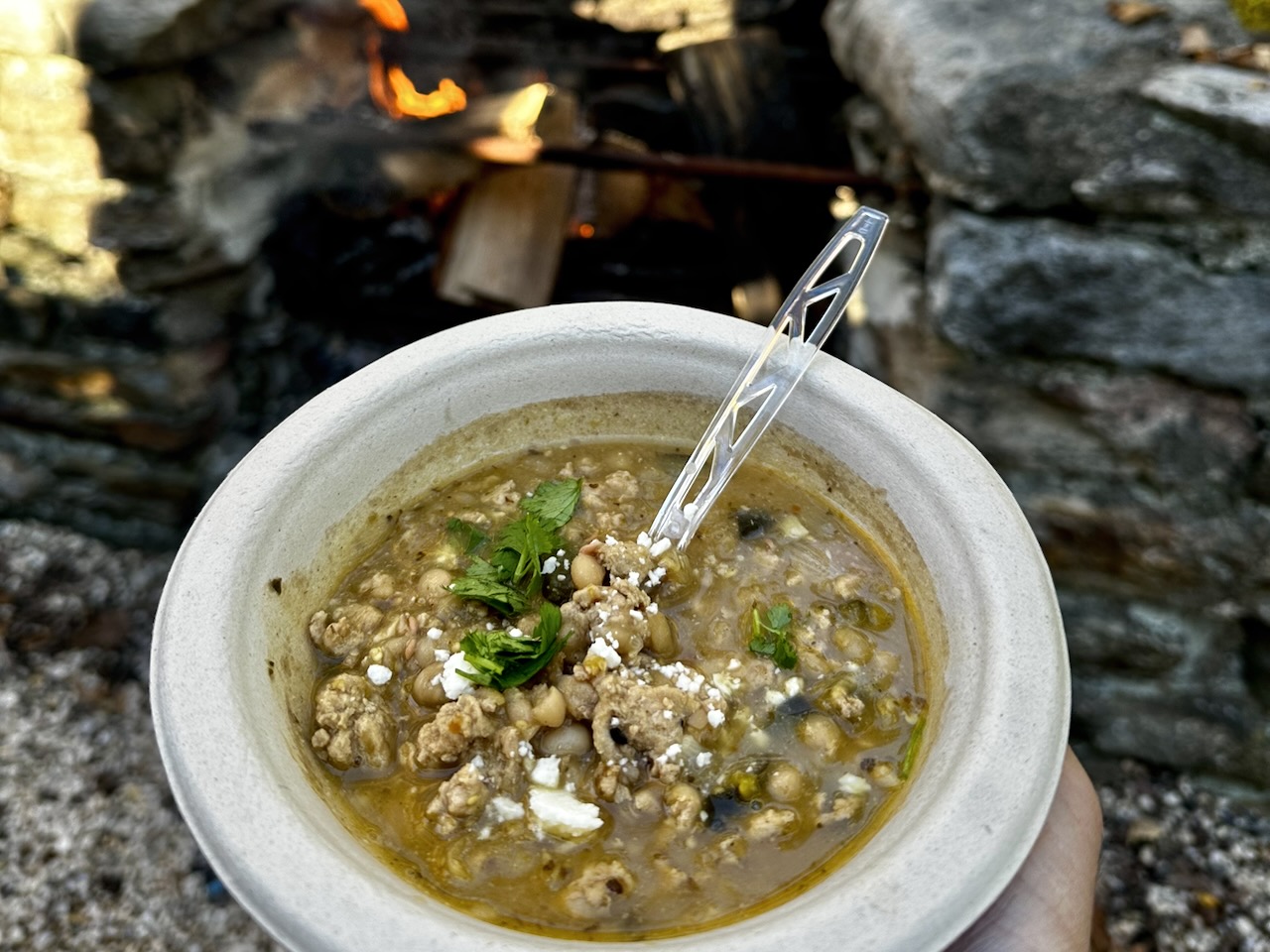
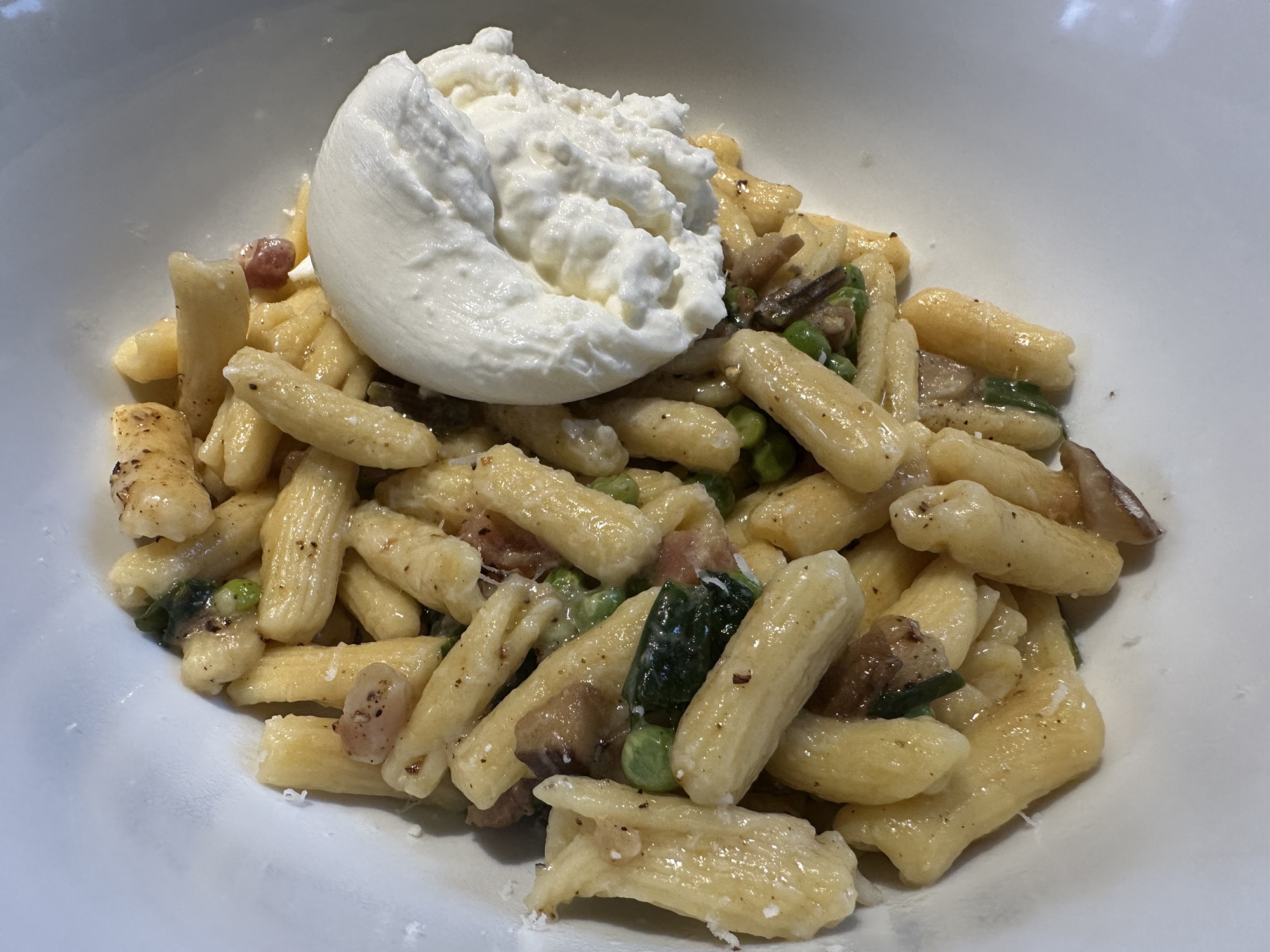
I stayed pretty true to the recipe this time, though I used ground chicken, a time saving shortcut I picked up from this NYT recipe a few years ago. Even though I used real chicken stock, I also amped up the flavor with Better than Boullion and some MSG. The tomatillos were from our garden, the last of this year’s crop.
It hit the spot on the chilly day and got lots of compliments. I’d definitely make it again.
Charlie is a pro at scooping out pumpkin guts.
Want a tip for easy pumpkin carving? Use a drywall jab saw.
Charlie’s pumpkin. He wanted to give it a mustache.
My ghost pumpkin.
I have a cup and a half of cooked alubia blancas in the fridge. What should I make with them?
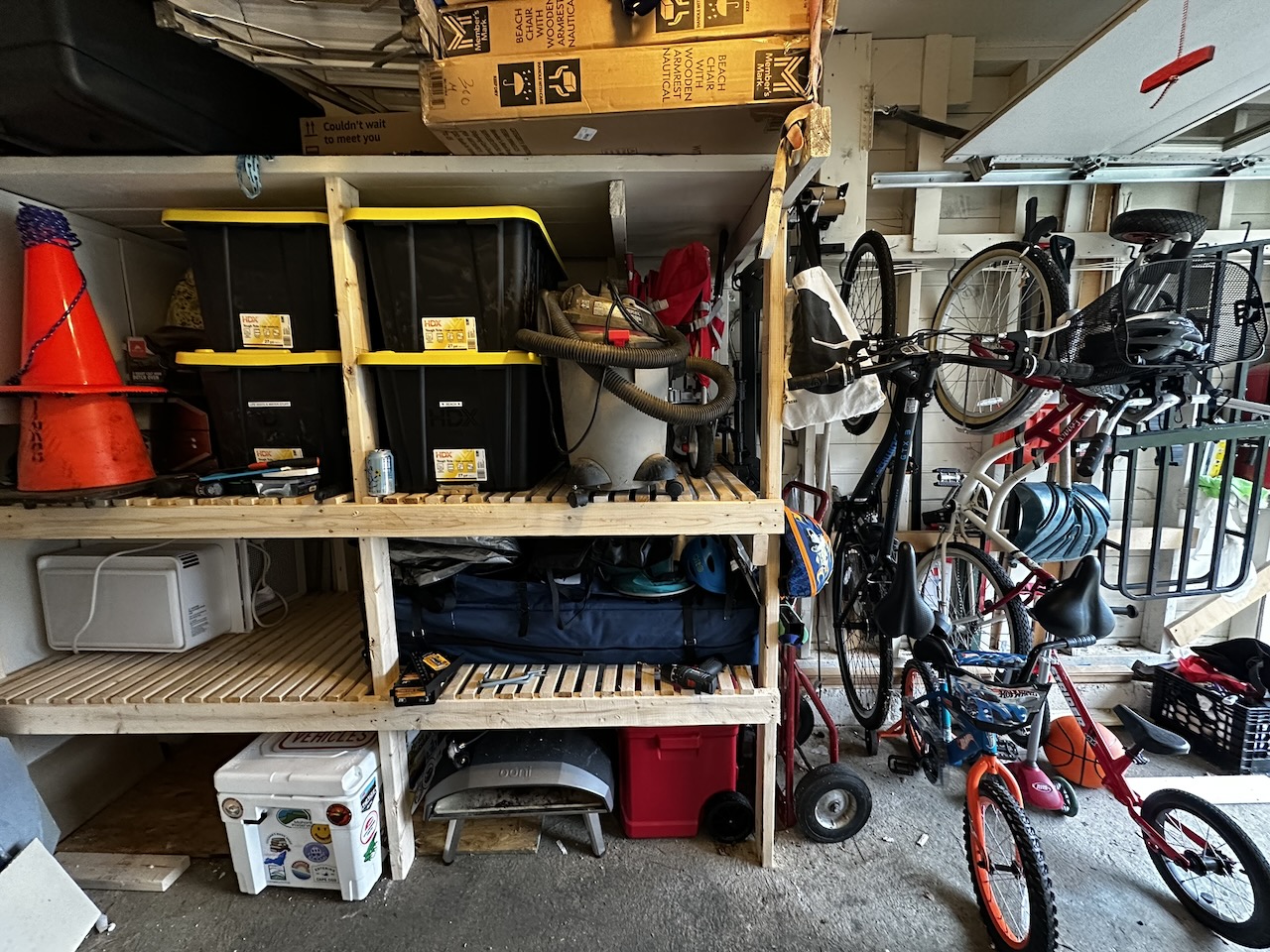
I finally admitted to myself that I’ll never get a vehicle in our one-car garage again, so I might as well build shelving to make better use of the space.
Weekends from the end of July to last week have been busy. This weekend was free, so I gave it a shot despite the rains from the nor’easter.
First I framed it out, working around the pre-existing shelf and cabinet. I originally planned on removing the cabinet, only to realize one of the previous owners had the existing shelf resting on top of the cabinet. Around it, then.
Then Charlie helped me measure, mark, and cut the slats, for which we used 1x2x8 furring strips cut into 32″ pieces. The idea to use slats instead of plywood came from Derek Hanson, who blogged about making some basement storage during his sabbatical. He wanted something that looks nicer than plywood, and I agree that the slats look great.
Charlie also enjoyed learning how to use the air stapler and how to use a spare board as a spacer. We used 1/4″ x 1 1/2″ staples.
Almost finished.
Finished and starting to load it up.
All loaded up with room to spare!
As you can see off to the right, I also put up hooks to hang bikes and various trailer hitch accessories (bike rack, storage rack, boat swivel.)
More organizing and cleaning to do, but off to a good start.
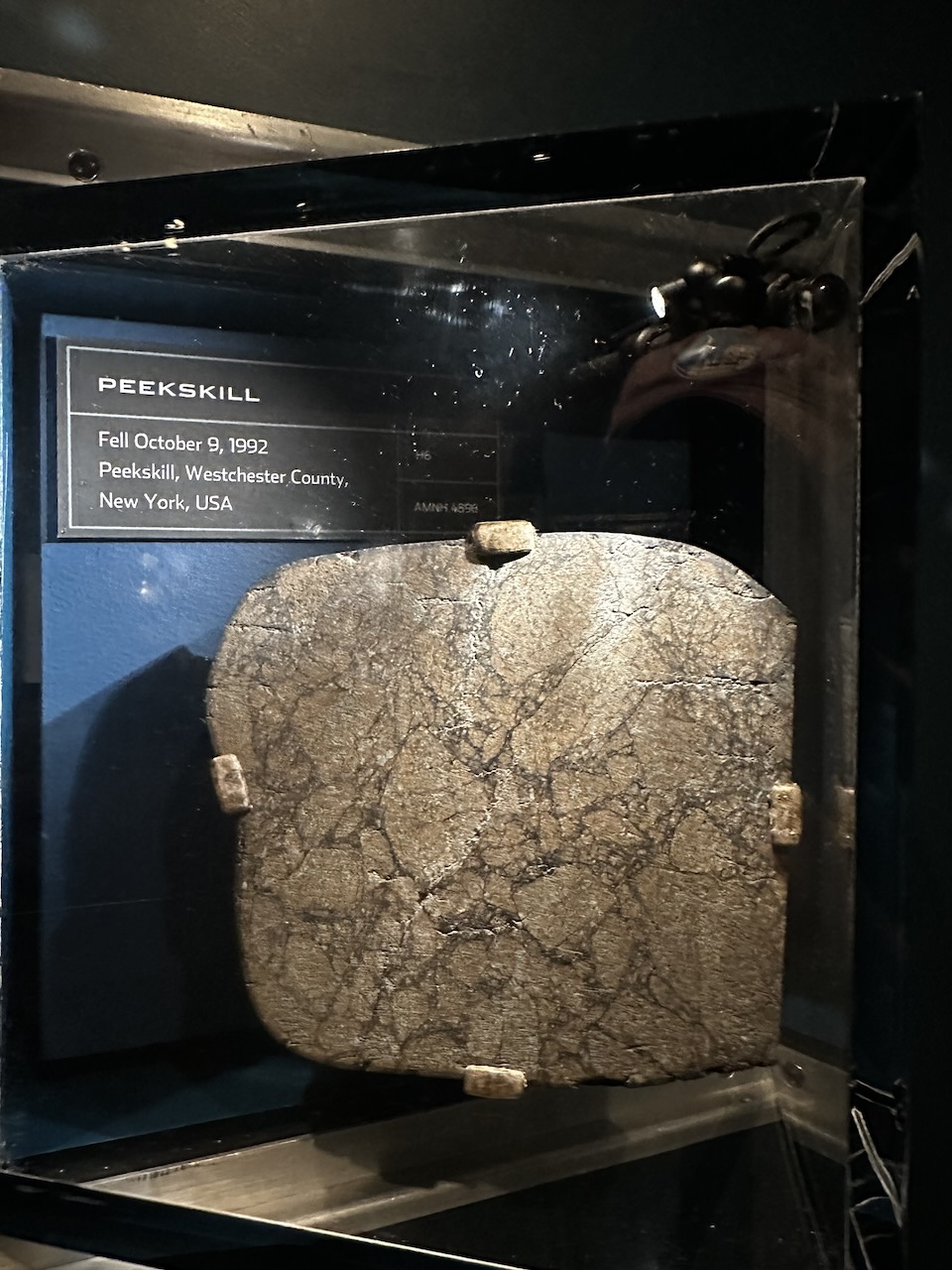
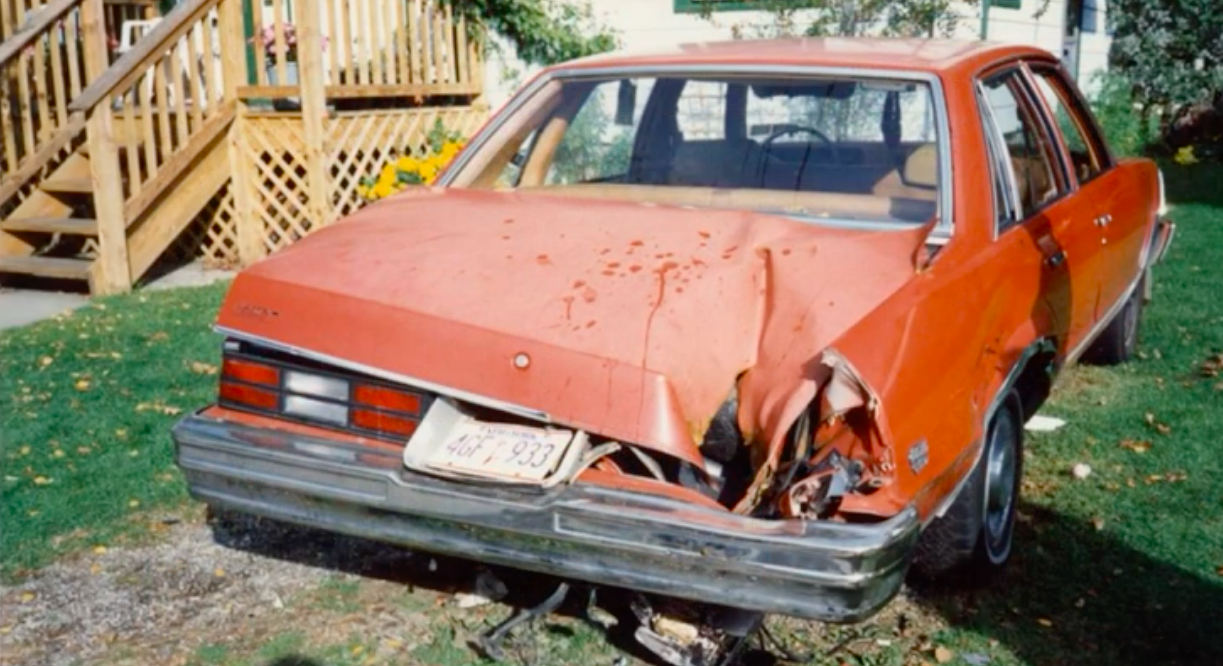
I love local interest at museums. Today Charlie and I found the Peekskill Meteorite at the American Museum of Natural History. It hit a car just a few blocks down the hill from where we live.
Charlie and I visited the American Museum of Natural History today and went to a counter to change a dollar into some quarters for the smashed penny machine.
The clerk asked, “Oh, do you want some blank pennies?”
I didn’t know want to say and must have looked confused because he added, “Because they are phasing out pennies, we keep these on hand for the souvenir machines.” I had a penny in my wallet, but I thanked him and took the blanks because I had never seen them before.
Neat!
It looks like you can buy a box of them online, though at $75 for 1000, they are a steep markup from regular ol’ pennies.
They seemed to work just fine in the machine, though they seem to match the modern post-1982 zinc-core penny, not the pre-1982 mostly copper penny.
Souvenir/smashed penny machines are already much harder to find than when I was a kid. My Dad had a collection, which I added to significantly, and now I’ve passed the collection and hobby on to Charlie. We still find them occasionally, though now I wonder how much longer they will last. Will anyone make new machines going forward, or will we be left searching out old ones in dusty tourist traps?
Will Charlie remember real pennies, or will the word become synonymous with a blank copper-colored circle used for novelty?
Living next to Blue Mountain Reservation, we regularly walk by and play in Dickey Brook. Beyond the crayfish and dace we see, I’ve been curious what else lives in there. The Big Apple Brook Trout project uses environmental DNA testing kits from Jonah Ventures, so I decided to buy my own kit and test out Dickey Brook.
Dickey Brook contains some deep pools, has lots of cover, and stays decently cool year-round. I was hopeful there might be some brook trout hiding below some of the deadfalls.
Charlie and I took a sample in late April. He loves trying to catch things with my net, so he worked on that while I pushed the water sample through the filter. In short order he caught some tiny snails, a frog, and a Blacknose Dace!
We got the results back a month later. Sadly, no trout detected from this sample, but what we got was surprising. Here is what it detected in Dickey Brook:
I was genuinely surprised by this one. I’ve never seen an eel in the brook and I didn’t realize the brook connects all the way down to the Hudson River, which is surely where the eels come in. I checked the maps, and after it goes into the ponds in Blue Mountain, there is an outflow that empties into Lents Cove, down by Charles Point / River Outpost Brewing.
I was up and out before dawn on Labor Day. The temperature on my dash read 57F. Now that water temps are back in the fishable range around here and we’ve had enough rain to keep the streams flowing, I was eager to get out.
As I pulled up to a spot I know well, there was already a vehicle in the pull-off. A tricked-out Subaru with a rod tube on top and a Patagonia Fitz Roy trout sticker, no doubt they were fishing. You know the type: Sage Euronymphing rod, C&F box full of perdigons, double chest pack, neck gaiter, Fishpond net three times the size of the largest fish in this stream. No thanks. I haven’t even finished my coffee yet. I wanted solitude. I cruised on by.
I decided to drive about ten minutes further to scout a new spot. I’ve been brainstorming new locations for DNA testing this fall, and there is one that we probably can’t do during the upcoming group training day because getting to it requires longer hike than we have time for. I thought I’d go check it out myself this morning to see if I could catch anything.
Getting to the stream took a mile hike of rocky bushwacking from the nearest road. The bugs were rough, but the flora was nice. I saw Jack-in-the-Pulpit fruiting, White turtlehead, Blue Cohosh, White Baneberry (Doll’s eyes), Jewelweed, and lots of ferns.
I almost gave up and turned back when I reached the stream and saw how choked the banks were with brambles and vines. I had to fight my way to the water’s edge, but when I did, a few shadows darting for cover caught my eye. I took a temperature reading: 61F. Promising!
I slowly crept to another break in the brush and stood still behind the shadow of a tree and watched. Then, I saw it: A 6″ brook trout holding in a sunny spot. I could see the vermiculation, red spots, and orange belly clear as day against the sandy bottom. That revived my sweaty, mosquito-bitten spirits. Though the moment I stepped out from behind the tree and tried to get a photo, I spooked it.
My hopes renewed, I headed upstream once more. I wanted to land a brook trout here. I found another opening in the brush about 100 yards upstream with a nice plunge pool. Despite my best efforts, my casts got hung up in the branches above the pool and I had to have spooked any fish there when the branch I pulled my line from fell in to the pool.
A new approach was needed. With the tight canopy and bramble-choked banks, I wasn’t going to make any delicate casts here. The bow-and-arrow cast might work, but that doesn’t give me much distance. I turned around to survey the section behind me and saw beautiful brookie water: A deep run for a stream of this size, still in shade, with overhanging banks and some roots and treelimbs dangling into the water. What could I do?
I noticed when trying to get my line out of the brush that there was enough current to slowly pull my line downstream. I decided to take advantage of that and toss my fly and leader downstream and feed line to match the slow speed of the current. With about 15′ of line out, I thought of Leonard Wright’s Fishing the Dry Fly as a Living Insect and gave the fly a twitch. The Sudden Inch.
Splash! Fish on. After a short fight, an 8″ brook trout came to my feet, then slipped the barbless hook as I tried to get a photo.
The next 30 minutes were a blur. Every drift brought a strike. The rest of the world faded away while I focused all my attention on that little clump of deer hair slowly floating away from me, waiting for that telltale splash and sudden tightening of the line to set the hook. By the end I had brought ten fish to hand, all 5-8″ brook trout.
As the sun moved overhead and the shadows on this spot disappeared, or perhaps all the splashing from those hooked fish finally spooked the others, the action on this spot slowed down and I wandered further. I found a nice pool at a bend where I could use the same technique and caught a few more fish.
I kept my phone in my pocket most of the time, but couldn’t resist a few photos.
I could do this all day, but it was time to head back to the car. I started bushwacking my way out again.
Further downstream toward the mouth where it empties into the reservoir, the stream is wider and slower. I skipped this section earlier because it looked more like panfish water than trout water to me. Though as I walked by on my way out, I saw some rocks and a deadfall, so I decided to see if anything was holding around them. The first cast brought a splashy take of my dry fly. 10″ brook trout that also slipped the hook at my feet while I tried to get a photo. I couldn’t just stand and look at these fish, could I?
This stream is absolutely full of brook trout. It felt like fishing in the Catskills. I caught more brook trout here in two hours than I have the rest of the season east of the Hudson. The cold, clear groundwater and shaded canopy keep the water cool enough for these little char to survive while the rest of the watershed heats up, and the mile of bushwacking leaves them relatively undisturbed, except for the heron and muskrat footprints I noticed.
There’s still another mile and a half of stream to explore. I’m eager to see what the upper reaches look like. Maybe I’ll try to find a different access point from the top and hike downstream next time.
After I got home, Charlie and I played with the dog in the backyard for a couple hours while Amanda got her nails done. Then we all went to King Kone for dinner and ice cream.
Labor Day isn’t the astronomical end of the summer, that’s a couple weeks away. But with Charlie going back to school tomorrow and the cool overnight temps, this weekend was the spiritual end of summer.
What a perfect way to end it: Catching brook trout on a dry fly, playing in the yard with Charlie, and a family ice cream outing.
Second use for the pot of alubia blanca beans I made Sunday night. We have a lot of tomatillos ripening now, so I was eager to use some. I went searching and landed on this recipe:
I don’t have good photos of my own to share of this one, but is was dead simple to make and came together while the fajita steak and veggies cooked on the grill.
This was a tasty one and I’d definitely make it again. Great side dish for at home Mexican food.
Mosquitos seem worse this year. Everyone in our house is getting bitten like crazy, and the wet spring and summer mean that the swampy areas around us haven’t dried out at all, extending their use as mosquito breeding grounds.
Two things are helping us get through it:
OFF! Fragrance Free Clean Feel
It works, has no smell, and dries quickly. No greasy feel. Repels ticks and mosquitos. Forget those patches that do nothing but make you smell like citronella and end up stuck to the inside of your dryer because you forgot to peel them off.
Benadryl Itch Relief Gel
This stuff works better for me than the various itch relief sticks and hydrocortisone creams we’ve tried.
Shoe dryer
We stayed at an AirB&B in the Catskills that had a boot dryer back in February, and decided we must have one. Essential gear for people who spend lots of time outdoors.
We use ours all the time. No more worrying if Charlie’s wet shoes will air dry overnight. We toss them on here, turn it on, and they are dry in a few hours. Useful for my wading boots, too.
I don’t have strong opinions on brands for these, since I’ve only ever used two. Having any shoe dryer is better than not having one.
Trying out a different approach to working beans into our meals during the week: Sunday afternoon I cooked a pound of alubia blanca beans on the stove and stuck them in the fridge so I can quickly use them in side dishes throughout the week.
First up: White bean and tomato panzanella from The Bean Book. I can’t find this one online anywhere and I don’t feel right sharing the recipe here, so you’ll need to buy a copy of The Bean Book or check it out from your local library. You won’t regret it. Great book.
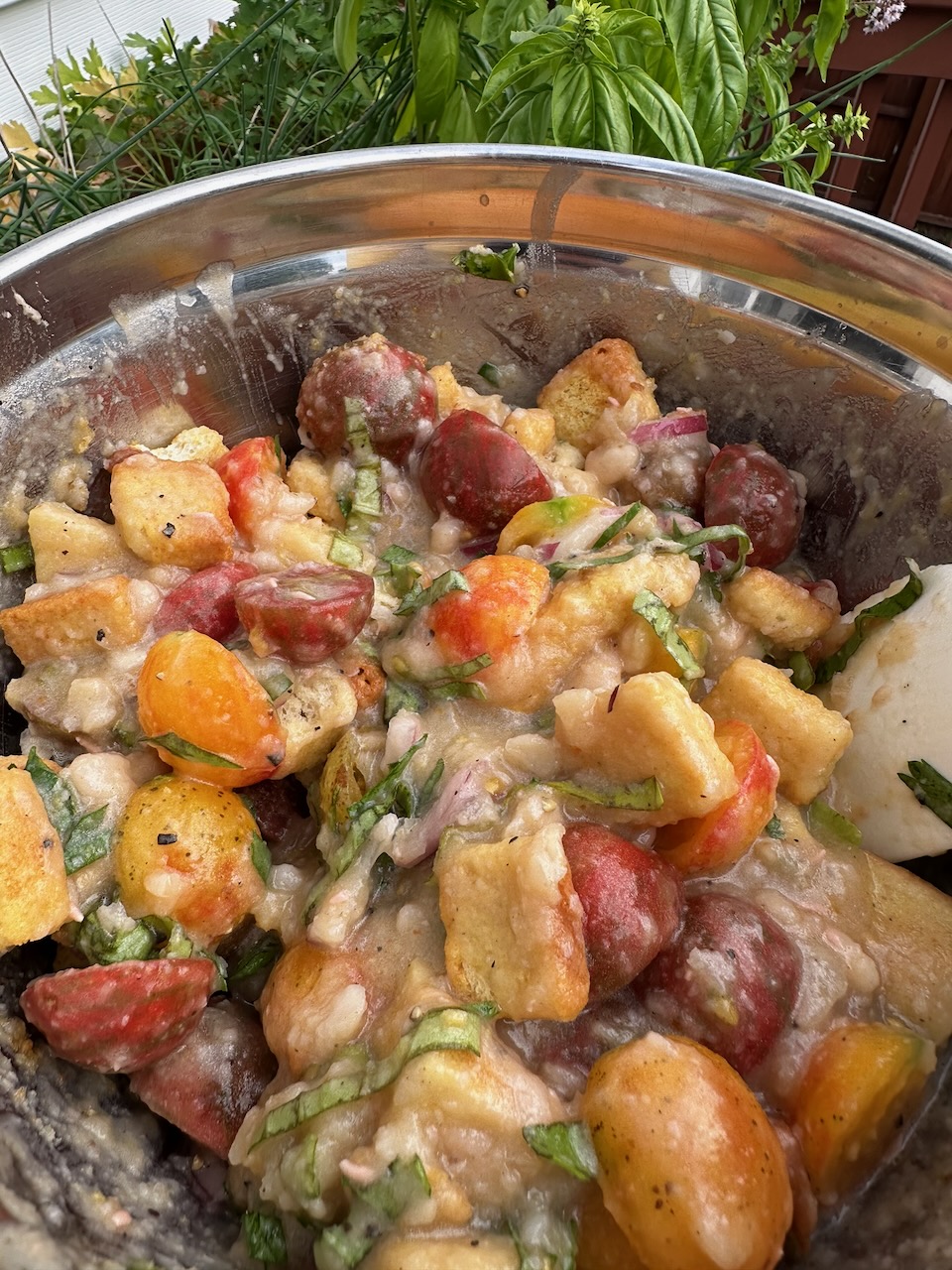
I used fresh tomatoes (bumble bee cherry tomatoes), basil, and parsley from our garden. Always lovely to use our own produce.
The dish:
It might have looked a bit more photogenic if I had drained the bean broth from the beans before I put them in the fridge, but I didn’t. Next time I will.
To give you a sense of what it tasted like, it had red onion, garlic, olive oil, red wine vinegar, salt, black pepper, croutons, white beans, tomatoes, basil, and parsley. It was acidic and herbaceous, and it was equal parts creamy and crunchy. It is served cold.
It was a cinch to make since the beans were already cooked. It came together while some sausage was cooking on the grill. I’ll definitely make this again, especially if I have a quarter loaf of dried out bread to use up.
I have two more dishes in mind for the rest of this pound of beans, both with tomatillos. One served warm, the other served cold. Stay tuned.
I had a couple hours of unexpected free time early this afternoon and made it over to my favorite local wild trout stream.
Even in the hottest part of the summer this small, shaded tailwater runs cold. While the other tailwaters here have warm water spilling over the dam after thunderstorms, this one never seems to spill. The releases and flows are remarkably consistent.
I rarely see anyone else on this stream, even when you’d be rubbing elbows with a dozen people on the other streams in the area.
Why do I so often get this stream to myself, even though it is clearly marked in the local fishing guides?
First, the trout here are small, wild fish. You’ll rarely catch anything larger than 8 inches, and when you do, it probably came up from the reservoir to spawn rather then being a permanent resident. I’ve read some old local guidebooks and it was apparently this way in the 70s and 80s, too.
Second, most of the stream is pocket water. There are four big pools on the steam, but most of it looks like this:
The great thing about this pocket water is that there is a small fish behind every rock. But they spook easily, and if you miss a take you probably won’t get a second one from the same fish. That’s okay, there’s plenty more here.
It has always been difficult for me to understand why so many trout fishermen spend most of their fishing time in pools or fairly smooth water and so little time working pocket water. Possibly-more likely, probably-they do not realize they are missing a good bet and some mighty interesting fishing.
A euro-nympher I ran into as I was arriving one day and he was leaving said, “I only come here when I can’t fish anywhere else because I kind of get tired of catching these small fish.”
Well, I don’t. I exclusively fish dry flies on this stream and love picking apart these pockets. It is hard to beat the thrill of reading the water, selecting a spot where you think a fish might be, carefully casting a dry fly, and being rewarded with a splashy take.
This one fell for a size 16 beetle. Terrestrials are often a good bet on this stream in mid-to-late summer.
Maybe one in every four times I fish this stream I might run into a kindred spirit who likes fishing pocket water for these small, wild fish, but even then it is never a concern. This stream runs two miles through the woods, without a road in sight.
Sweet solitude. Unheard of on a weekend on the other streams in this watershed.
This place has a lot to offer besides the fish, too. Life is abundant here. Frogs and toads, deer, mallards, herons, crayfish, coyote, owls, and macroinvertebrates. Trout lilies, ramps, and trilliums in the spring. Moss, ferns, fungi, and wildflowers in the summer.
Here’s a few that caught my eye today:
Today I found myself hoofing it back to the car as a thunderstorm rolled in. Despite the hurried dash, I made it back to the car feeling more calm and refreshed for having wiled away three hours rock hopping and casting dry flies to wild brown trout in cold pocket water.
I’ll take the solitude and small fish here to jockeying for a spot any day.
Ghost Pipes popped up after the recent rains. This is my first time seeing one being pollinated!
Since they are white and pop up after rain, I assumed they were a fungus, but apparently they are a plant!
It is striking in appearance because it is completely white in appearance, although individuals can have pink coloration and black specks. How does this plant survive without the green pigment chlorophyll? Chlorophyll is responsible for harnessing the sun’s energy to produce carbohydrates, a process known as photosynthesis. Ghost pipe saps nutrients and carbohydrates from tree roots through an intermediate source, myccorhizal fungi in the genera Russula and Lactarius.
Today I fished the small headwaters of a stream I drive by daily that eventually empties into the Hudson River. When I say small, I mean small. The average depth of the section I fished on state land is probably 6in, with an average width of 5ft.
I saw lots of eastern blacknose dace in the stream, but something slightly different caught my eye too, so I stuck my phone down in the water to record a video to be sure:
Yes! Swimming around with the blacknose dace is a tiny trout parr. I took a temperature reading: 60F, even in shallow water. Great sign on this 85F day. I got out my fly rod and started working the pocket water.
I wasn’t getting any hits at all on my dry flies (I tried a size 16 Mr. Rapidan and a size 18 BWO Sparkle Dun), so I tied on a size 16 bead head hares ear nymph and started working the three pools on that section of the stream.
In the deepest of the three, probably 8 ft deep, a decent sized fish followed my fly right up to the edge and then caught a glimpse of me and swam away with a splash. That caught my attention. It was the only thing bigger than a dace I’d seen. I had to know what it was!
After about 5 minutes of slow casting, I got a strike, but whatever it was didn’t take the fly. I decided to put a tiny indicator on at around 5ft of depth and let the fly slowly float through the pool. The indicator disappeared on the fourth retrieve and I set the hook. The fish jumped out of the water and I knew I found what I came for. I had a trout on the line.
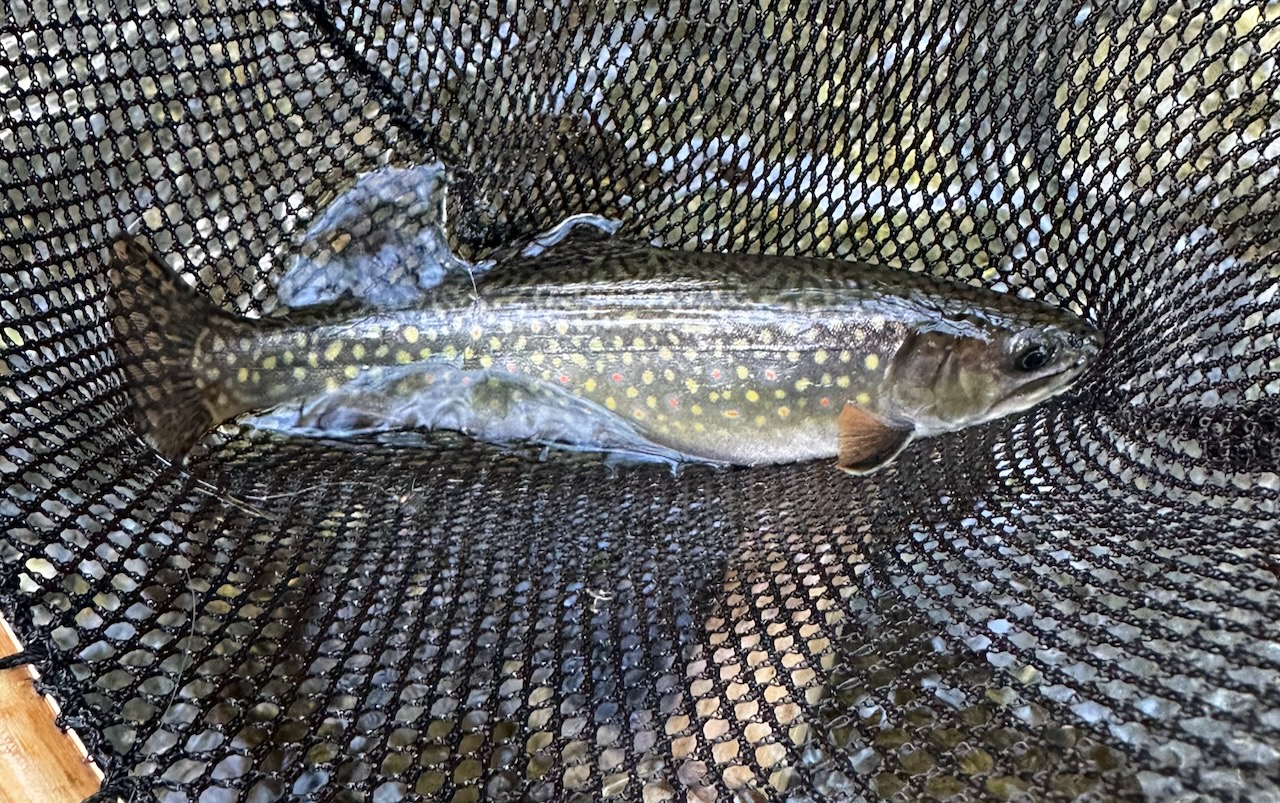
Not just any trout… I caught a brook trout!
What surprised me was the size. 9 inches! I expected something in the ~5in range since the stream is so small. A healthy 9in brook trout was a great thing to find.
I quickly let it go and we went our separate ways. It swam back down to the depths of the pool and I hiked back up the stream to the car.
What a delight to find another stream with native brook trout close to home.
Note to self for my next tying session: More size 16 and 18 bead head hares ear nymphs to sink to the bottom of holes like this.
Jay Guarneri wrote a great article in the 2026 edition of Tenkara Angler about collecting zenmai from ferns and tying kebari with it. He inspired me to go out and collect some of my own zenmai this spring.
What is zenmai? My Best Streams calls it “cotton of flowering fern” and has this pop-over info box:
Flowerring Fern “Zenmai” sprouts about from April to June and those sprouts are covered with cotton. Zenmai is distributed in the Korean Peninsula, China, Taiwan and the Himalayas. The same kind of Zenmai is distributed worldwide except Australasia. There are Yamadori Zenmai / Cinnamon Fern (Osmunda cinnamomea), Yasha Zenmai (Osmunda lancea), Oni Zenmai (Osmunda claytoniana), Royal Fern (Osmunda regalis), besides Zenmai (Osmunda japonica). The cotton of zenmai is often used to the body of traditional tenkara fly. The people who lived in the mountain village spun the cotton of zenmai into thread and made the winter clothes in the old days because this material has performance of water proof. It can be said that it is a wisdom of the mountain village’s people. It is also well known that the sprouts dries and becomes food.
Jay recommends looking for Royal Ferns, Cinnamon Ferns, and Interrupted Ferns here in the eastern US. I had a hard time finding them in the woods by our house. Almost all of the ferns I see regularly are not species that make the cotton.
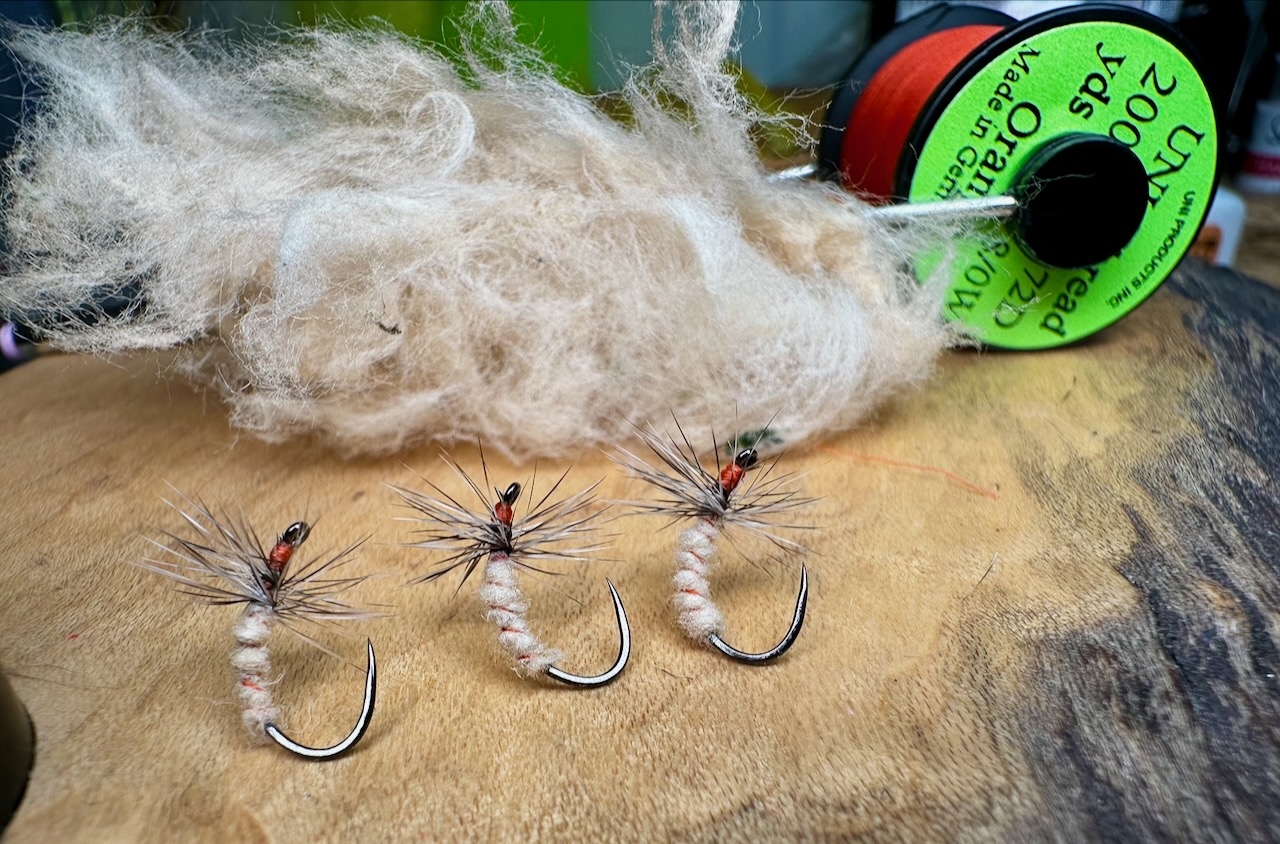
I finally found a patch of Cinnamon Ferns today near a brook and collected about a dubbing pack’s worth of zenmai.
I found the stuff fairly easy to dub with a little wax on my thread. Though as Jay pointed out when I was messaging him on Instagram, I was lucky to get some nice straight fibers, which makes dubbing easier.
I chose to tie futsu-style kebari in size 14 with orange thread and grizzly hackle.
I’ll probably tie some hen pheasant soft hackles next.
I also want to go out and collect some more. I collected from maybe 1/20th of the patch I found. Another bunch similar to what I collected today should do nicely.
Want to buy some zenmai kebari? Go check out Jay’s Kebari Shop on Etsy. He sells them and they look better than mine.
Today during our Trout in the Classroom macroinvertebrate sampling we had something very cool happen: Dozens of tiny BWOs (blue-winged olives) emerged right in our sample bins! Afterward we could see the shucks in the bin. It was great to be able to show the students this happening in realtime.
Also, here is a nice example of a stick caddis we found today:
Marie and Jay invited us over for dinner. Charlie loves playing with their cat, Maisie, so I took a little break from tying stripe bass flies to tie a hookless cat toy for Charlie to take over.
Just different feathers, no flash, because I don’t want the cat to accidentally eat plastic if it gets too excited.
I call it “Maizy’s Deceiver.”
I tied it on a swivel clip, which will be able to clip to the end of a cat toy wand they already have.
Maizy, and the elusive other cat, Bob, seemed to enjoy playing with it.
I used multiple colors on this one, relying on dyed feathers. For the next one I plan on using all natural feathers that haven’t been bleached in any way. I wonder if the cats will enjoy the natural scent?
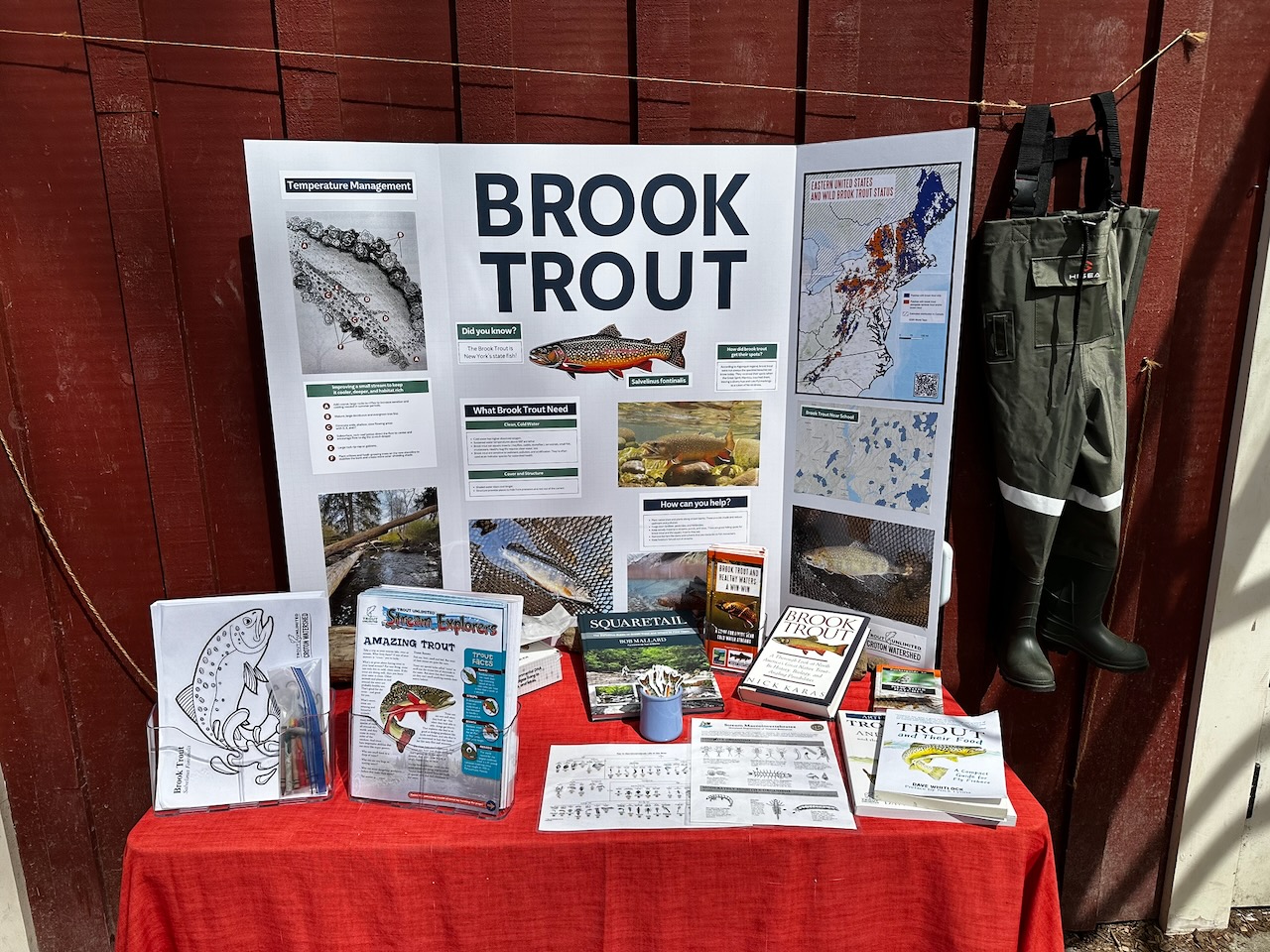
Charlie’s school had an Earth Day event today and I set up a table on conserving brook trout, New York’s state fish, and the only trout native to the eastern US.
I put together some stuff for all age groups:
Coloring pages for the younger students
A pamphlet on the trout life cycle for middle school students
A pamphlet with information about brook trout and conservation tips for junior high students and adults
Books to look at
Info on the bugs trout like to eat in streams
Maps of known brook trout populations in the local area and the eastern seaboard
A diagram on stream temperature management
An Algonquin legend about how the brook trout got their spots as a gift from the Great Spirit
The younger students loved the coloring pages, too. Here’s one someone colored:
Amanda helped me make the poster board. I sent a bunch of materials and copy her way and she laid it all out beautifully. Thank you for your help, love!
We had a really fun afternoon at Charlie’s school. It was interesting to see what the students gravitated toward. Some liked the trout, some liked the bugs, some wanted to talk about fishing, some wanted to know about why I like brook trout so much.
Do you want to do a brook trout conservation table? I put together some resources to get you started:
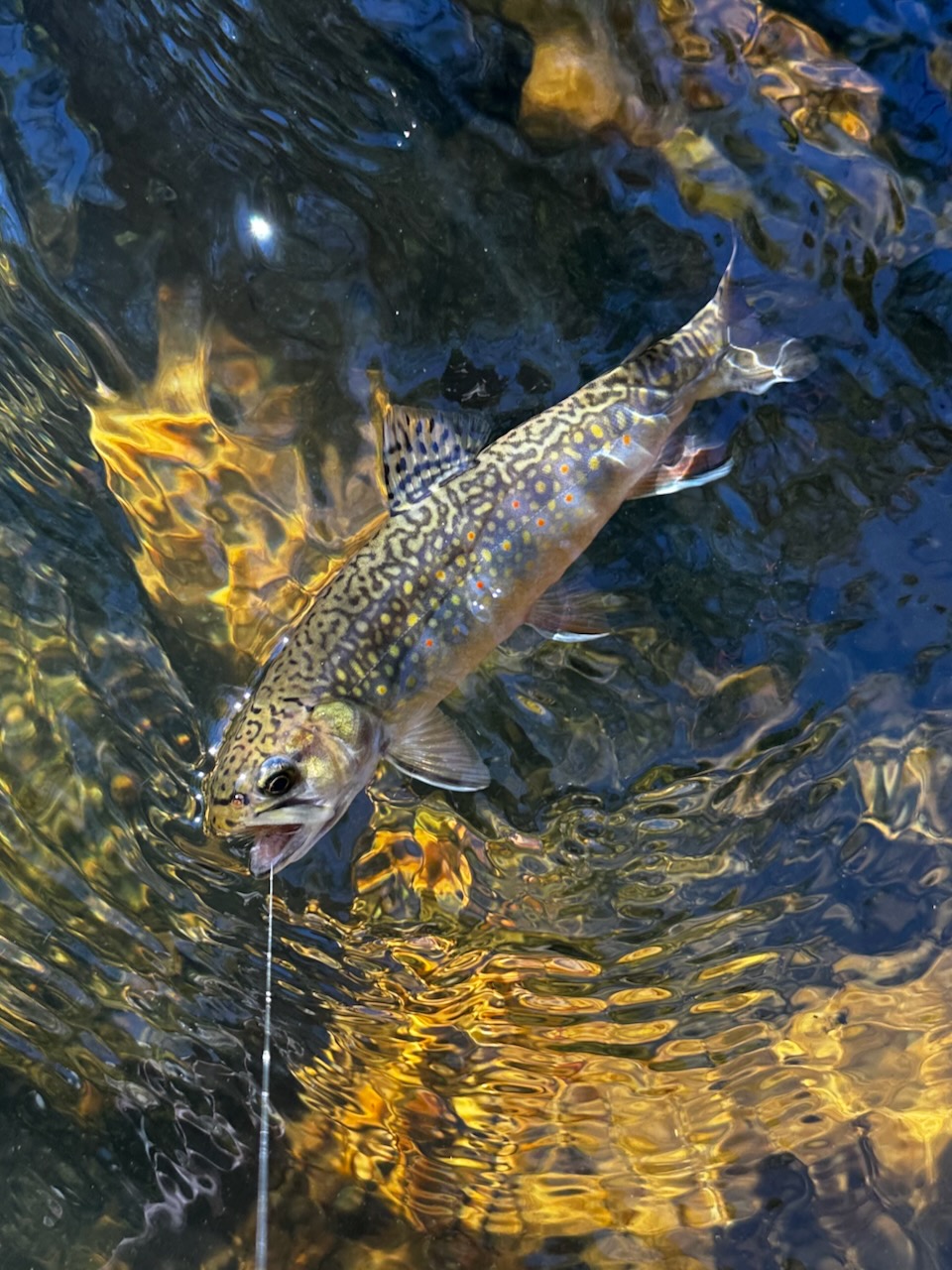
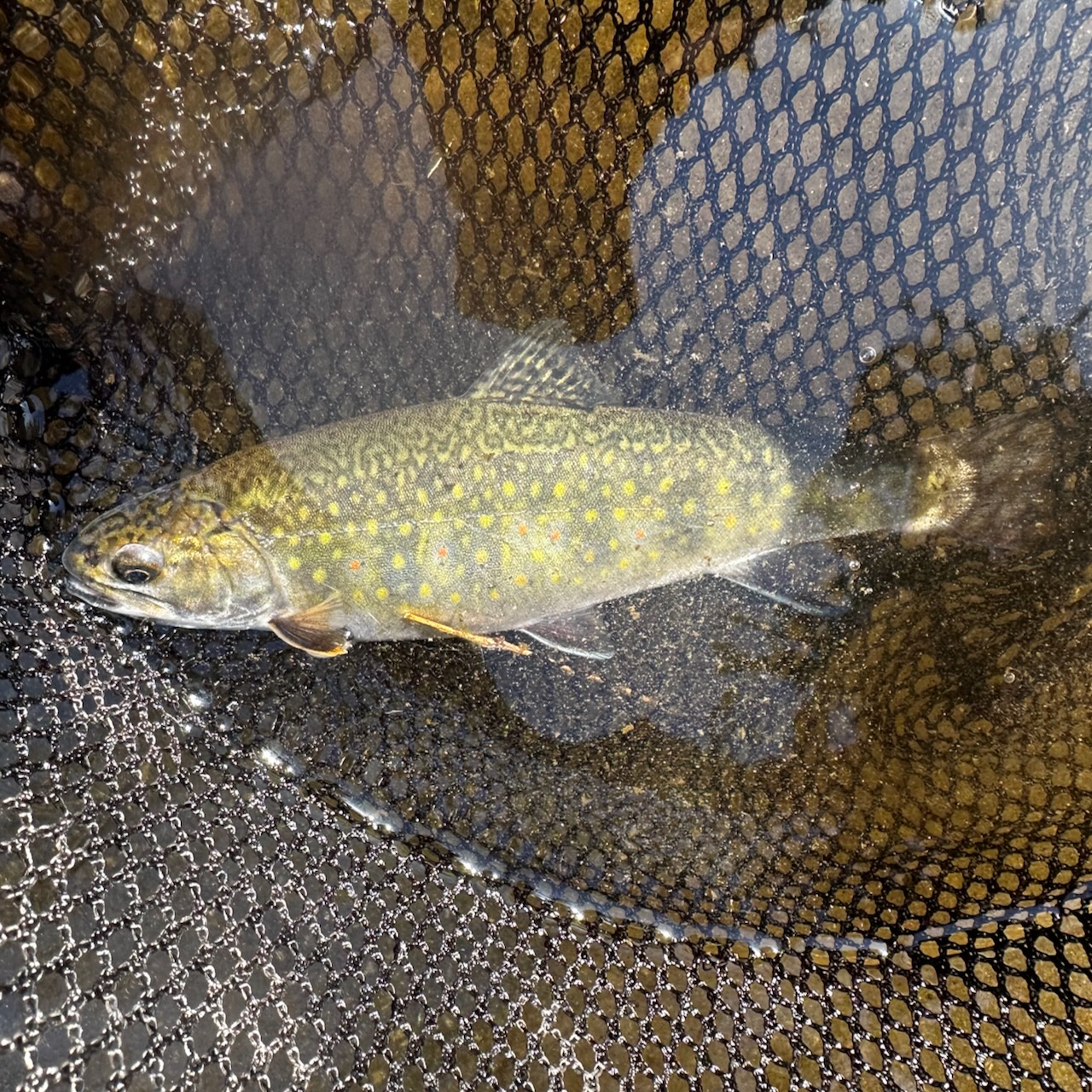
Today I caught a beautiful wild brook trout today in Westchester County, just five miles from my house. I’d heard whispers that this small stream contained brook trout, and I was delighted to catch one on my first outing there.
I’ve caught brook trout in Cross River, but since so much stocking goes in there, it is hard to tell whether they are wild or holdovers.
But in today’s stream, which I’m not going to name here, I am pretty certain this brook trout is wild, as there are no stocking records I can find for this stream.
New technique: Sticking your iPhone down in the water while running a video to film the fish swimming away.
A beauty!
I caught it in classic brookie territory: Around the deadfalls.
The stream also has some nice macroinvertebrate life, including some giant stoneflies and some free floating caddis, both of which are indicator species of clean water, which was running at 54F today.
This stream is a wonder. Small, but full of life. I also saw a turtle trying to disguise itself as a rock:
This small stream is a gem hidden away in Westchester. Who would have thought we have wild brook trout here? We do. Let’s conserve them.
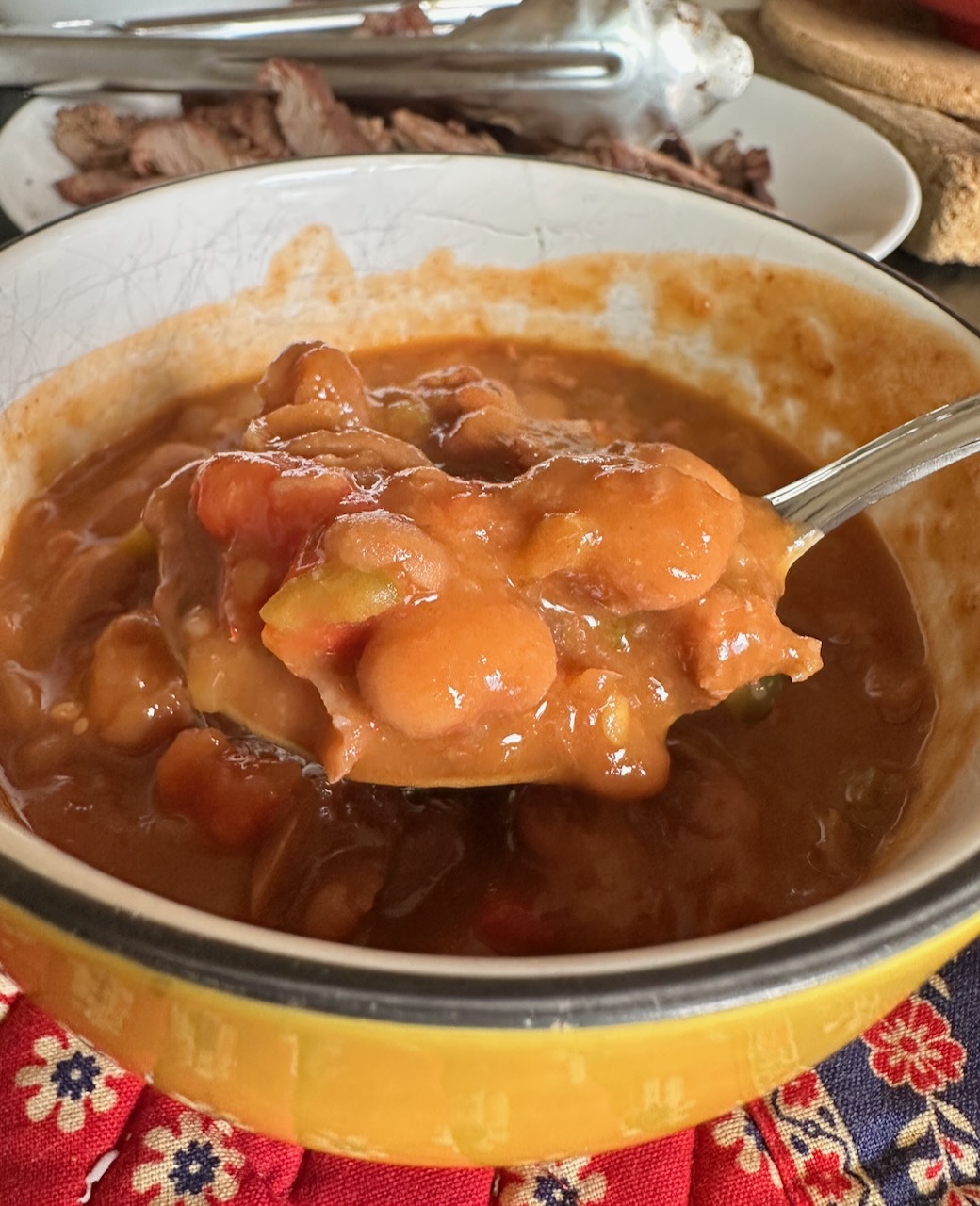
For this week’s bean adventure, I made Charro Beans, or Frijoles Charros. I looked at multiple recipes and cobbled together my own, which I’ll attempt to put down in words here:
1lb dried pinto beans, soaked for four hours then cooked with onion, carrot, and bay leaves.
4 tbsp bacon grease
1/4lb Mexican chorizo
1 serrano chile
4 garlic cloves
1/2 red bell pepper
1/2 poblano pepper
1 cup chopped tomatoes
Salt
Notes:
I didn’t put any bacon in there, thinking the bacon grease + chorizo would be enough. Next time I think I’ll add bacon. I think this would be a good use for bacon ends you sometimes see on sale in butcher shops.
I know charro beans are typically soupy, but I cooked this batch down until they were a little thicker, which is how I prefer them.
I ate these frequently last week: On the side in a bowl, as an ingredient in tacos, as the sole ingredient in tacos, and in breakfast tacos. Delicious, versatile dish.
Since I made a full pound of beans, I had plenty of leftovers.
What do you do with leftover charro beans? According to Arnie Tex, you turn them into Frijoles Puercos.
I used a blend of Arnie’s recipe and this recipe from Maricruz Avalos:
I used Oaxaca cheese, which Charlie calls Mexican String Cheese. It basically is!
The Frijoles Puercos were great. We ate it as an appetizer the first day, then the next day we put it in breakfast tacos with scrambled eggs. Highly recommended.
Amanda even put some on a hot dog in place of chili, and now she is requesting that I make another batch soon.
I think I’ll make some for the next friend hang cookout.
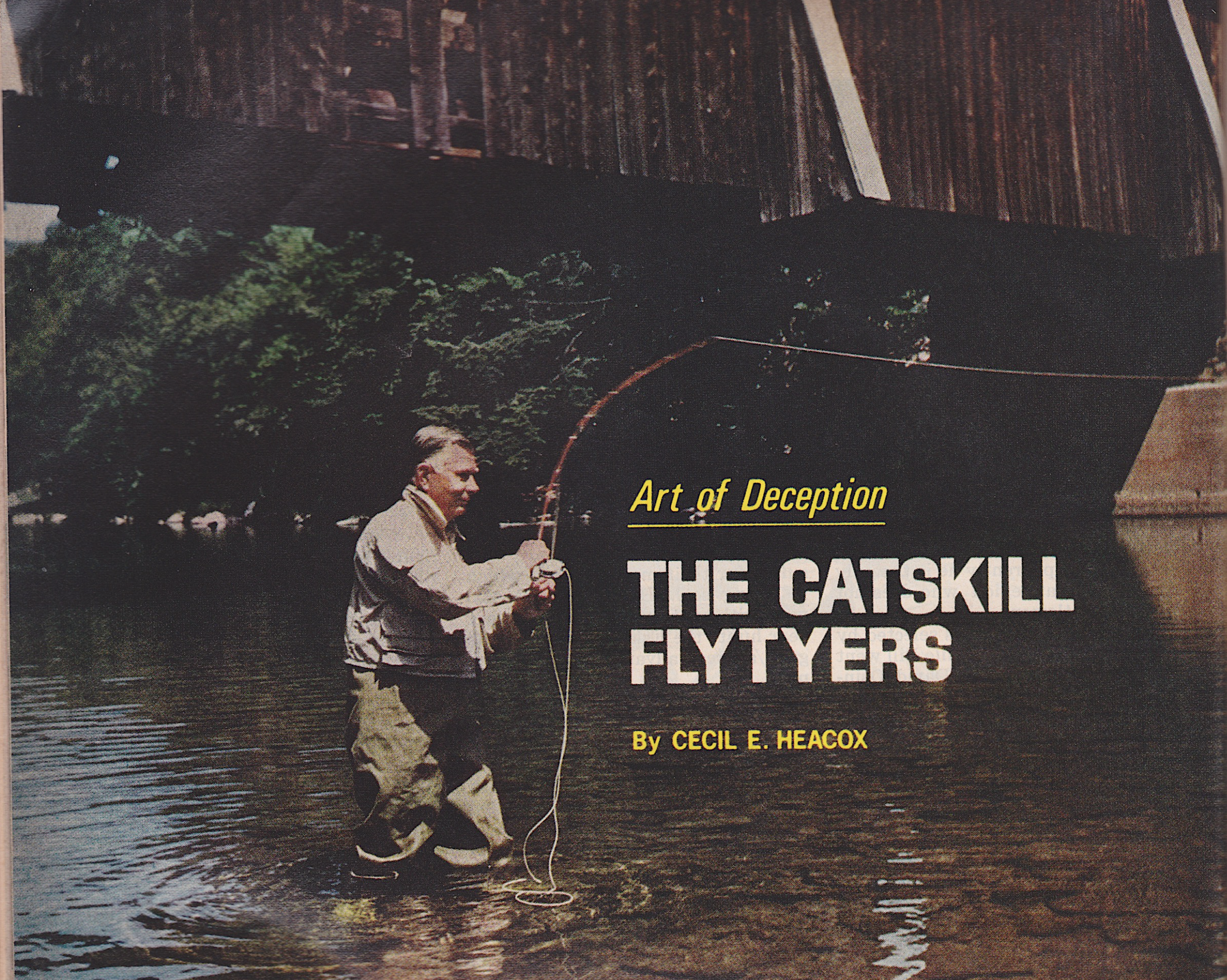
At some point, I think someone needs to publish a Cecil Heacox Collected Works project. Perhaps that is my responsibility, now that I’ve confronted the possibility. If you want to help with that, let me know.
I walked and fished the section of the Pocantico River running through Rockefeller Preserve to document disturbances with TU’s RIVERS app as part of the Big Apple Brook Trout program.
Some main takeaways:
I documented some erosion and some places I’d be concerned about surface runoff, but in general this is a pretty well maintained section of stream.
The water temp was warm for this time of year. Mid 60s in most spots, as high as 67 in one spot. I get that this is the lower section and the past couple days have been hot, but that is higher than I’d expect.
There is already some conservation work happening. Some removal of things like Knotweed, bolstering the banks against erosion with large rocks, some young tree plantings.
The office said that the local Trout in the Classroom program is changing this year and they only allow brook trout releases there, no brown trout releases. The state still stocks brown trout, though. I wonder if we can change that?
I caught a young largemouth bass and hooked up with that I’m pretty sure were two small (6-8in) brown trout, but they didn’t make it to the net. Both slipped my barbless hooks at my feet (from what I did see of them I noticed the lighter upper body, so pretty sure they are the smaller stocked browns). Lots of rises today, though, in the three bigger pools in this section of the river.
The largemouth bass I was surprised to catch when I was casting to rising trout:
After three weeks of walking through the woods at night looking at vernal pools with a flashlight, I finally found a spotted salamander!
They are slow on land, but pretty quick to swim away and hide in water. I had to be patient and wait about 30 minutes for this one to come back out after I initially spooked it.
Charlie and I have been keeping an eye on the patches of Trout Lilies in our local woods, and today they were in full bloom.
Much to my dismay, I learned after lugging my SLR out that I had forgotten the memory card in my card reader on my desk. So iPhone photos will have to suffice.
We also saw some Wood Anemone and fiddlehead ferns:
Charlie found a black and yellow feather that we think is probably from a Northern Flicker.
Lots happening in our yard, too. Arugula, radishes, and volunteer tomatillos are sprouting, the rhododendron, forsythia, and tulips are blooming, and the yard is full of violets.
Jon and I got out today on the Croton River for the first row of the season.
Charlie and I spent some time earlier this week scrubbing out the guideboat and getting it cleaned up. Despite being wrapped in a tarp in my boat racks behind the workshop, some raccoons found their way in and made a mess.
Inspired by Brian Schulz, I picked up some Aere Beach Rollers to use as float bags in the guideboat. Think of them as repurposed inflatable dock bumpers.
I’ve never flipped, but they give me piece of mind going out in the Hudson during windy weather, and when taking Charlie out. I strapped them in with 4ft x 1in straps.
They did not interfere with my rowing, and I found them comfortable as arm rests and to lean my legs against. They also had a secondary benefit of holding my removable seat in place, even when the boat is upside down on top of the car.
Tertiary benefit: Decent makeshift fly rod holder.
Jon and I plan to do some tests when it is warmer out. We’ll row up to a favorite swimming hole and flip one boat with float bags and one without float bags and compare the difficulty we have in recovering them. Both of us know how to self-rescue in kayaks, but haven’t tried in the guideboats before, so it should be interesting.
One of the main draws of the Adirondack Guideboat is the overall stability because of their shape and displacement volume. Still, good to be prepared, especially when a 4yo is a passenger.
Speaking of Charlie, he didn’t go with me today because I don’t feel comfortable taking him out on the water when it is this cold. The water temp was 53F and the air temp was around 56F. Too cold for someone without much body fat who is still learning to swim. I promised to take him out as soon as it warms up.
As Jon and I were rowing back downriver, someone on a dock waved us over. We met Gareth Hougham of the Hudson Valley Stream Conservancy, who recognized our Adirondack Guideboats and wanted to see them and chat with us. Gareth is a delightful guy doing great conservation work in the area, and I’m glad we got to meet.
A secondary reason for going out today was to try casting a fly rod from the guideboat for the first time. Can you believe I’ve had the guideboat for almost 5 years and hadn’t cast a line from it yet? I brought my 8wt striped bass rod and cast it around the mouth of the Croton River, though still on the Croton side of the train trestle. Way too windy today to go out into the bay.
I didn’t catch anything, but I did get some practice casting from the boat and now all my gear is ready. I’ll go out again soon and target some striped bass for real.
Nice evening out on the water. Looking forward to the 2026 season.