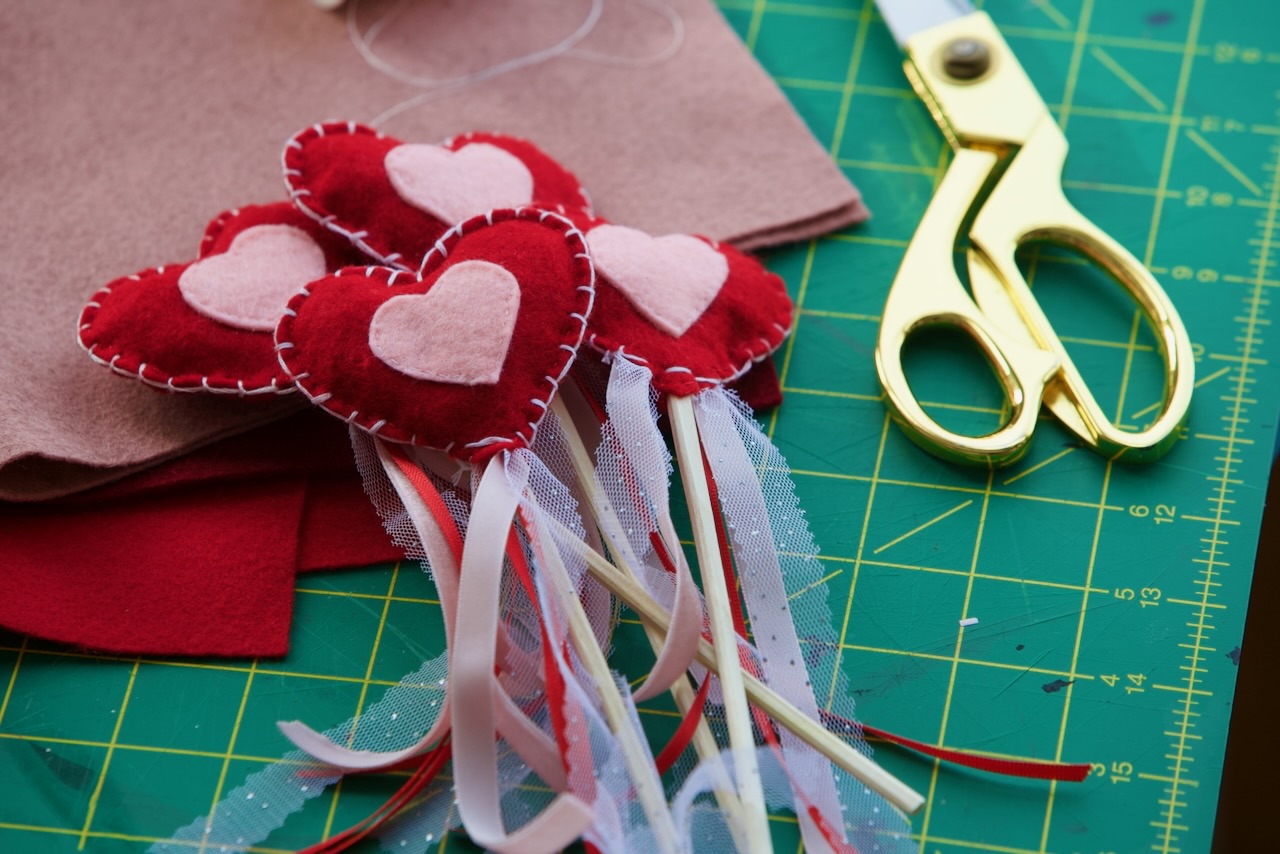
Amanda and her friend Megan have been working on a project to support the local immigrant community impacted by ICE.
Hi friends. We’re excited to share a little something we’ve been working on for the past few weeks — after bedtime, during swim class, and on the couch while our families watch Cars (Charlie) or Frozen (Miles) for the 10 millionth time.
The world feels so heavy right now, but we believe that little acts of love compound.
If you’re in the Westchester area, we hope you’ll pick up a wand for your kids. If you’re not, we hope you’ll reach out for our free DIY guide to make your own … and maybe you’ll sell an extra or two. And if you’re not crafty, we hope you’ll feel inspired to use your own unique gifts to spread some love. We can’t wait to see what you do.
With love, Amanda & Megan
Here are a few more photos of the heart wands they are making:
This week in Slack, Matt encouraged us to visit a museum for a couple hours during the work day.
We live ~30 minutes from Dia:Beacon, which I visited twice even before we moved here.
I messaged a couple coworkers who live in the area to see if they were free and wanted to join me. Automattic is a remote company, so I haven’t met the majority of my coworkers in person, only virtually. Ben Janes joined me and had heard great things about the new Tehching Hsieh exhibit.
It didn’t disappoint.
Tehching Hsieh is a performance artist, best known for his year-long performances of locking himself in a cell, punching a time clock hourly, living completely outside, being tethered to someone but unable to touch, and eschewing all art.
I’m not usually into performance art, but the way the projects were displayed at this exhibition made me reconsider.
In the prison cell gallery, I was drawn in by seeing the actual wooden cell, bed, and bucket, and imagining what daily life must have been like.
In the time clock gallery, I was delighted that you could see the pattern of missed hours by looking at the bottom of the rows. It might have been even more striking if they placed the empty spaced where the missed hours were, seeing blanks at random spaces around the room. Did he have an uberman sleep schedule or just a good alarm?
I was also captured by the timelapse video of the snapshots and seeing the timestamps work their way up the cards behind him. The pile of ~5280 chads was neat, too.
In the outdoor gallery, I couldn’t stop thinking about how difficult it must have been to take care of private things outdoors. I loved the maps he recorded daily, a forebearer to Foursquare and Strava.
In the tether gallery, I was less interested in the daily recordings and more deep in thought about the psychological consequences of the lack of physical contact, despite the proximity.
In the no art gallery, the emptiness made sense, but the artist statement sheet having the colors inverted was a nice touch.
The 13 years of private art gallery being the long empty gallery was nice as well.
At the end, I loved the visualization of the timeline, to scale by the day, of Hsieh’s performance art between 1978 and 1999. It put the galleries in perspective.
In all, a really well done exhibition that will stick in my mind for a long time, alongside the Sol LeWitt retrospective at MASSMoCA, the Matisse paper cuts exhibition a MoMA, and the Picasso museum in Malaga.
While at Dia:Beacon, I couldn’t help but walk though the Richard Serra pieces again. My favorite.
While I walked through them, there was a mother, grandfather, and a 3 year old in the space, too. The 3 year old was joyfully listening to her shouts echo, which reminded me of when I took Charlie there in 2022, when he was 9 months old, and he enjoyed listening to his little “ah!”s echos, too.
I also liked some aspects of the Renée Green exhibition, primarily around color assignments.
One evening last week I had the idea to draw some quick sketches to illustrate some concepts in the Praxis curriculum. I used my iPad, Apple Pencil, Procreate, Paper by 53Archived Link, and Pixelmator.
Instead of another try at my portrait, I decided to try another drawing with a focus on light and shadow, so I set up a swinging arm lamp to light up a coffee cup on a pedestal.
I drew it live and took a photo afterward. The photo isn’t from the exact perspective I viewed the cup from, it is from a little lower.
Today I filled in the details of yesterday’s drawing and fixed some of the scale issues. It isn’t perfect, but I’m going to call it complete today and move on to another drawing tomorrow.
Today’s drawing is still in progress. I had a busy day today and spent the entire evening down in the city, so I only got about 30 minutes to start a drawing of a leaf on the cover of this book I’m reading. I’m going to work on filling in the details tomorrow.
Today I did a quick sketch of the Broadway Bridge over the Harlem River on my iPad.
After I completed the drawing, I saw multiple places where I messed up the proportions and perspective. In particular, I made the bridge much too wide. I’ll pay particular attention to that tomorrow.
Today I decided to take a break from the specific Drawing on the Right Side of the Brain exercises and try out drawing on my new 10.5″ iPad Pro with the Apple Pencil. I used the Linea app and did another pass at my Day 8 hand drawing.
I don’t yet have fine control over the Apple Pencil. I’m still getting used to it. I love using my finger as the eraser and doing each part of the drawing as separate layers (outlines, details, and shading). I found shading much easier to control on the iPad than with a real pencil. I’m still going to do exercises in my real drawing pad, but I’ll probably shift a decent number to my iPad. One of my goals for learning to draw is being able to draw illustrations for my blog, which will all be done digitally.
Today I drew a portrait of Amanda’s profile. She graciously sat at the table and worked while I drew and revised.
This was difficult. I don’t feel like I nailed it. Should the eyes be further back? Did I get her nose right? How do I handle the shadows and subtle curves of the cheek and jaw?
Burning the midnight oil. Today I read about expanding the sighting and spacing I’ve been working on the last few days to faces. Then I spent about an hour applying what I learned to a line drawing of a portrait by Sargent.
Here is the comparison:
Tomorrow I draw a profile portrait of a real person. It will probably be Amanda.
Today I did exercises to learn how to draw perspectives. The first was about finding scales and angles, then the second was a drawing of a complex scene to put those to use. I chose our entryway, complete with a crooked doormat and a pile of our shoes.
I think the left side came out much better than the right. I spent more time on it. I rushed the right side because I spent more time and I wanted on the left and started to get impatient.
It turned out better than I could have done a week ago, but it took much more time, energy, and focus that I expected.
Today I had to draw a chair, but not in the usual way. Instead of drawing the lines and shapes that make up the chair, I had to draw the negative space instead. I didn’t take a photo or use the plastic pane very much, but drew from looking at the chair and occasionally using the frame to check proportions. This exercise is supposed to help with noticing negative space, framing, picking a guide for scaling, and comparing angles. After I was finished, I erased out the tone from the area between the shapes I drew. In this case, that ended up being the chair.
I don’t think I nailed the proportions. The top is rough. The only area what I think is strong is the triangle area between the right leg and the seat.
I repeated yesterday’s exercise, but this time with a fountain pen in my hand, cap on. It took me about an hour. I still don’t quite get the shading, but it is becoming easier to zoom in on details and lines.
Today I did my first “real” drawing. Not a trace, not an upside down copy, but an actual drawing. I focused with one eye on my hand and drew the lines and curves the best I could.
I still don’t really know what to do with shadows, highlights, etc, but I’m pretty pleased with my first actual drawing. It is a lot better than I would have come up with 8 days ago, so shifting the way I see seems to be working.
Tomorrow I’m going to try the same exercise again, this time holding an object in my hand as well.
Today I did an exercise to help see like an artist sees: Using a plastic viewfinder to create a flat plane, resting it on my hand, and then using a non-permanent marker to trace all of the edges. (Reminder: In drawing, an edge is where any two areas meet, not just an outline.)
I did this four times with my hand in different foreshortened configurations. I noticed that I tended to close my right eye each time I did the exercise in order to help me focus on my hand in a 2-dimensional way. I’ll remember this for the future when I’m framing up a real drawing.
Here are some photos I took along the way:
I know that I was just tracing what I saw, but each time I removed the plastic frame, I was surprised at how well it turned out. It looks remarkably like my real hand.
Tomorrow I’m taking this exercise a step further: Instead of tracing my hand on the plastic, I’m going to do my best at drawing it on actual paper.
Today I read a section on childhood drawings and then did another exercise to help me shift my perception: Pure Contour Drawing.
I put my pencil on the paper pad, scrunched my hand together, turned so I couldn’t see the paper, and then tried my best to draw the creases I saw in my hand while a 5 minute timer was running.
It yielded a strange result, but the point was to intensely focus on edges (in drawing, that is where two items come together) to the exclusion on everything else. Over the 5 minutes, the world drifts away as you get lost in the complexity of your scrunched palm.
Tomorrow: A modified version of this with the viewfinder and my whole hand.