Chuck Grimmett

Philosophy of work

Taxonomies

  • Take Notes During Your Next Crisis

    Take Notes During Your Next Crisis

    The best time to learn how to handle crises is right after you just had one. Analyze what happened, what you did to solve it, and then make a checklist for when it happens next time.

    Then, during your next crisis, take a deep breath and start jotting down notes of what is happening and what you are doing. This makes your post-game analysis easier to complete.

    We had a mini crisis at work today: Some of our sites weren’t connecting to our MySQL servers and we couldn’t figure out why. The problem was intermittent. Our sysadmin is on vacation, so a few of us had to jump in and try to figure it out. When we were in a holding pattern while waiting for our hosting provider to call us back, I made a checklist of what we need to do the next time this happens. This took into account what we had to figure out on the spot, look up, diagnose, and what we learned. Now we have it for the future.

    H/T to Episode 279 of Back to Work with Merlin Mann and Dan Benjamin. I listened to it this morning and their discussion of making checklists while traveling for travel made me think of doing this during the MySQL issues.


  • There are Multiple Paths to the End Goal

    There are Multiple Paths to the End Goal

    Today I learned:

    There are almost always multiple paths to your end goal. If you are stuck spinning your wheels on one path, try another.

    If you get stuck, write down your end goal and then write down the discrete steps you need to get there. Then, at each bullet point, ask, “How can this step be eliminated or completed in a better way?”

    Every time I go through this exercise I get some traction and start moving forward again.

  • Summing with Filters in Excel, Reminding Yourself “Why”

    Summing with Filters in Excel, Reminding Yourself “Why”

    Today I learned:

    Summing in Excel with Filters

    If you’ve ever tried to write a sum() function in Excel while you have filters on, you likely didn’t get the result you expected. The sum() function adds up what is in the raw cells. It does not take whether or not they’ve been hidden via a filter into account.

    subtotal() is the function you are looking for. Specifically, subtotal(9,range). The 9 refers to sum for hidden (not at a result of filtering, though) and non-hidden rows. See the documentation. subtotal() functions only on the results of filtered data.

    =SUBTOTAL(9,G1670:G640501) gave me the sum of the the filtered data from G1670 to G640501. (You can see why filtering would be important with such a large data set!)


    Remind yourself why

    Sometimes I spend too much time and effort trying to convince myself to do something I don’t want to do. This leads to general angst and despair.

    My wife reminded me yesterday that the best way of convincing myself is to reflect on why I’m doing it in the first place.

    Whatever your reason why is, as long as it outweighs the cost of not doing it, you’ll get over it and find a way. I keep an index card with some why bullet points on it nearby to keep things in perspective.

  • WordPress Plugins, Development Planning for New Developers

    WordPress Plugins, Development Planning for New Developers

    Today I learned:

    Development planning for new developers

    Philosophies like Agile Development are great for teams working on large projects, but for someone just getting started with development and working on small projects, they can be a little much. For situations like this, Readme Driven Development strikes the right balance of planning out your project, writing documentation, and actually doing the work.

    Write your Readme first! (H/t to Eric Davis for telling me about this.)


    WordPress Plugin Basics

    I have a food & drink website where I post regularly. Lately I’ve been trying lots of kinds of coffee to dial in my ROK Espresso maker and I’m starting to reach the limits of how many I can accurately remember. I’ve been wanting to make a WordPress plugin for a while, so why not make a plugin that makes a Coffee Reviews custom post type? (The main goal here is to write my own plugin and learn how it is done, so please don’t suggest already made plugins that I could use.)

    I’m using WordPress’s Plugin Handbook to learn the basics.

    Barebones

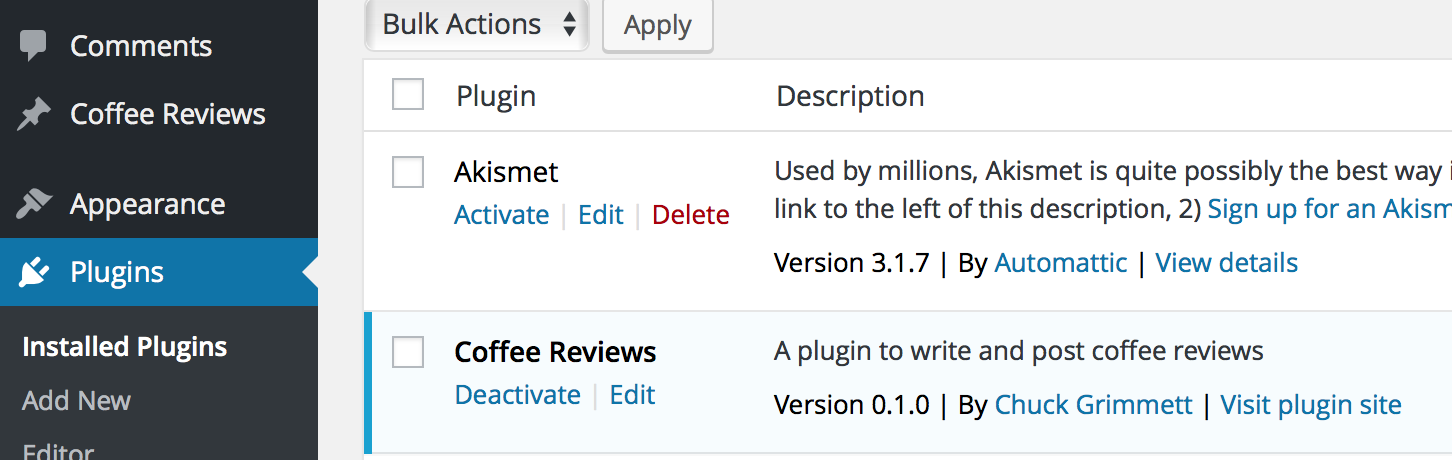
    The most basic WordPress plugin is a PHP file with a plugin header comment. Here is mine:

     /* Plugin Name: Coffee Reviews */

    You’ll eventually want a lot more in the header. Here are the requirements.

    Hooks

    Hooks allow you to tap into WordPress without editing the core files. (Rule #1 is to never edit the core files.) You pass functions through hooks to extend or change WordPress functionality.

    The register_activation_hook() runs when you press “Activate” on a plugin. Since I’m making a custom post type, I’ll want to use the activation hook to refresh permalinks once the post type is created. If your plugin needs a custom database table, you can create that with a function passed to this hook.

    The register_deactivation_hook() is basically the reverse of the activation hook. When you deactivate the plugin, the items passed to this hook fire. I’ll want to clear the permalinks again.

    I made a barebones plugin tonight that registers the custom post type. I definitely have more work to do, but saving, hitting refresh, and seeing this appear never gets old!

    barebones plugin

  • Thoughts on Providing Solutions, Learning, Culture, and Distractions

    Thoughts on Providing Solutions, Learning, Culture, and Distractions

    I didn’t do much technical work today besides some front-end debugging. Instead I did a lot of administrative and project management work and ended up thinking a lot about how I work.

    Here is what I thought about.

    Always provide a solution

    As a consultant, you aren’t paid to tell people they have problems. They already know that and chose to hire you. It is your job to provide solutions.

    Instead of being negative or saying that a proposal can’t be done, try to get at the heart of the request and offer an alternative solution. You and your clients will be much happier.

    As things get frustrating, it is easy to take the, “look how messed up this thing is” route. But that isn’t your job. You need to roll up your sleeves, brew some coffee, and come up with a solution.

    Learning

    I find time and time again that I retain so much more of what I learn if I’m applying it as I’m learning. So why do I continue to use books with pre-designed activities that I mindlessly copy? Because it is a lot easier than coming up with a project from scratch.

    From now on I’m applying what I learn in my own way. No more copying examples. I’m going to figure it out and learn it the hard way.

    Culture

    • Sometimes you need to find software that is a better fit for your culture. But sometimes you need to take a hard look at the culture and its ability to adapt if there doesn’t seem to be any good solution.
    • Like learning, sometimes cultural change only comes the hard way: Adapting because it is necessary.

    Distractions

    • Second screens are great for productivity when you are in the zone. Unfortunately they are also great for procrastination when you aren’t in the zone. Sometimes you need to turn that second screen off and focus on one thing at a time.
    • Filter, filter, filter. Reduce the number of things that can distract you. If you don’t need to make a decision on it, don’t let yourself see it. For example, in Excel, if you only need to read items that have a specific attribute, filter your view by that specific attribute and hide the rest.

    Idea for a Slack bot: What is distracting you right now?

    • Regular messages (10, 2, and 4?) via Slack
    • Respond with comma separated items that are distracting me.
    • Save those responses in a database for later analysis
  • Doing the Work, Flipping the Status Quo, and Alphabetizing in Liquid

    Doing the Work, Flipping the Status Quo, and Alphabetizing in Liquid

    Today I learned:

    Doing the Work

    I used to be really interested in how people worked. When they get up, what their morning rituals are, what tools they use, how they use them, etc. While these things are interesting and tell a story about a person, they miss the point.

    How someone works isn’t nearly as important as the fact that they are doing the work. They made the choice to do what it takes each day to practice their craft. The rest is minutiae.

    If using the GTD method or having morning rituals works for you, great. But don’t think that those things are what really matter. If you’ve committed yourself to doing the work, you’ll find a way. If you haven’t committed yourself, none of the rituals or methods will make a difference.

    This commitment is very difficult, but necessary.


    Flipping the Status Quo

    We all suffer from status quo bias. How do we overcome it? We can get 80% of the way there by:

    • Instead of asking, “Why should this be different?” ask “Why should this stay the same?” – This is especially powerful when confronting clutter. (By the way, the answer, “because it gives me joy” is a valid reason for keeping something. Change for change’s sake isn’t helpful.)
    • Recognize the difference between acknowledging a feeling and rationalizing that feeling to keep the status quo.

    Source: Planet Money episode #683


    Sorting tags alphabetically in Liquid

    It was starting to annoy me that my tags were not in alphabetical order on my Today I learned page. So I learned how to sort them alphabetically with Liquid and I added anchor links with counts for each tag.

    Here is my updated template code:

    1 2 3 4 5 6 7 8 9 10 11 12 13 14 15 16 17 18 19 20 21 22 23 24 25 
      	{% assign sorted_tags = (site.tags | sort:0) %} 	 	 	{% for tag in sorted_tags %} 	  {% assign t = tag | first %} 	  {% assign posts = tag | last %} 	 	

    {{ t | downcase }}">{{ t }}

    {% endfor %}

    Sources: I cobbled this together from Michael Lanyon’s blog, Joe Kampschmidt’s blog, and the Liquid docs.