Chuck Grimmett

Outdoors

Taxonomies

  • Casting Out Winter

    Casting Out Winter

    Overnight we turned the clocks forward an hour. This afternoon the temperature on our weather station reached 66F (18.9C). The sun went down an hour later as the clock reads, so Charlie got to play outside longer than normal. The skunk cabbages are emerging.

    It feels like we turned a corner and spring is on its way in.

    I went out to the upper west branch of the Croton River (the west branch reservoir outlet) this afternoon for a few hours to cast out winter and the cobwebs that have accumulated on my casting form.

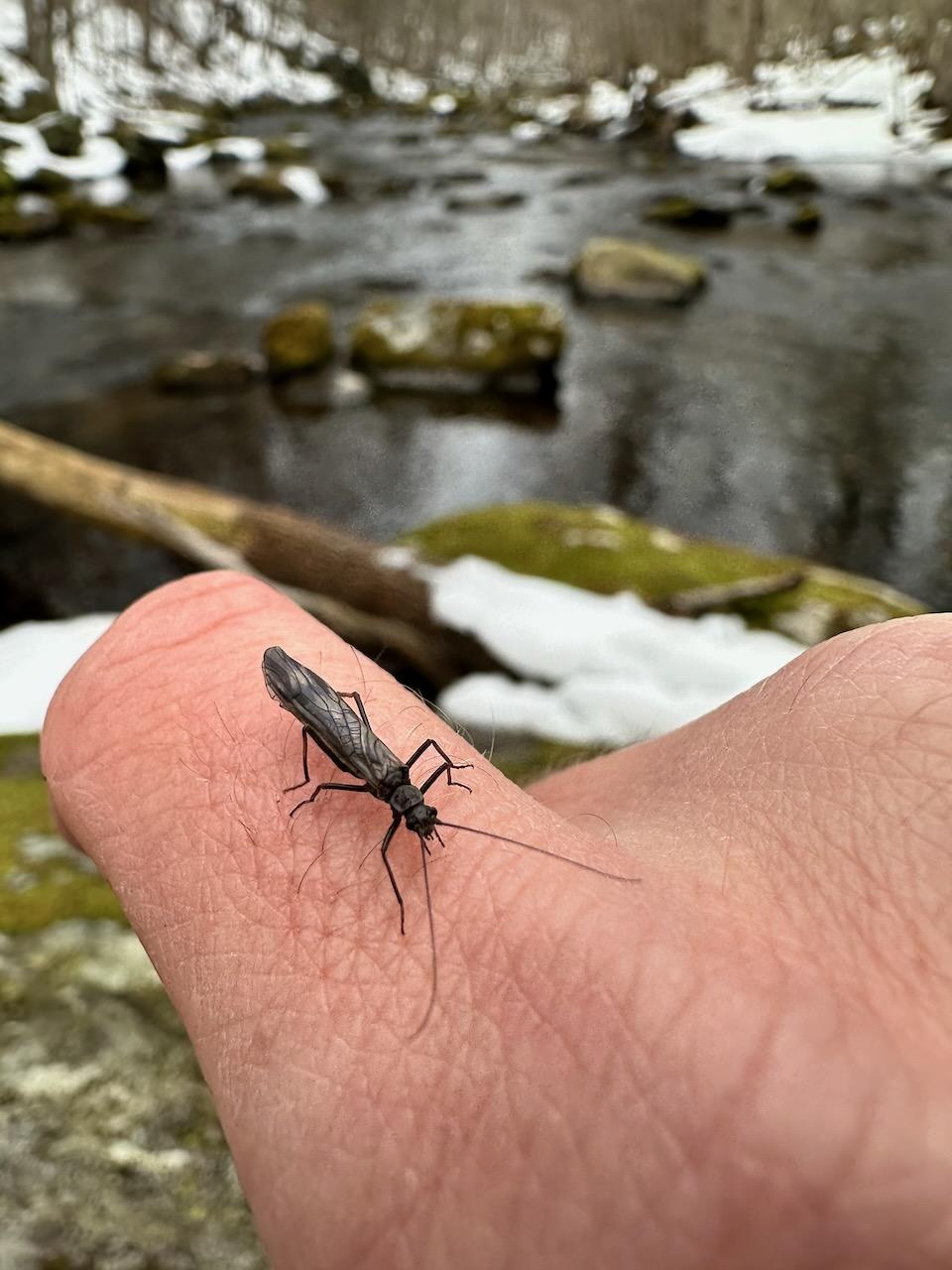
    I was delighted to see lots of little black stoneflies on the rocks and some tiny BWOs in the air.

    A couple nights ago I tried some dry versions of the little black stonefly, hoping that I’d run into some on the river. This pattern comes from Mark Sturtevant and features a peacock body, CDC wing, and grizzly hackle.

    I also tied some glass bead dark sakasa kebari and some size 20 CDC BWOs.

    I’m glad I tied the dry little black stoneflies. I was rewarded with an 8″ wild brown trout, the average size for that stream. My heart started racing when I saw it take my fly, then immediately dropped when I realized it had spit it out. I took a breath and carefully cast again to the same spot, a feeding lie below where water funneled between two large rocks. The little fish snatched my fly again, and to my delight, I hooked it. I quickly brought it to hand, and just as quickly released it back from whence it came.

    My first fish of 2026, on a dry fly no less.

    The banks were still icy and the water was 41F (5C), so we still have a ways to go before the sulfurs start hatching, but I’ll take the little stoneflies for now.

    The warm sun, when it peeked out from behind the clouds, felt invigorating. The breeze was mostly chilly, but every now and then a gust of noticeably warm air would blow by, and it felt like standing in front of a vent. It was a welcome feeling after this long, cold winter.

    I was surprised that there was still so much snow on the ground there in Carmel. Over in Peekskill almost all of our snow is gone. I hiked a little over a mile upstream to fish a section I haven’t fished before, and the trudging was slow going.

    A kind whitetail led the way for about a half mile and led me to a shallow crossing before some steep terrain. I was also fortunate enough to see a blue heron out doing some of its own, and a freshly excavated pileated woodpecker feeding hole.

    While trudging, I noticed a spot where something had eaten a mallard. I noticed the distinctive feathers right away. I suspect a bird of prey, because there were no footprints around the rocky bear spot littered with feathers. I selected a few subtly barred flank feathers from the scattered remains. Perhaps I’ll tie a few patterns so the duck can return to its river in a different form.


    When I got home, Charlie was happily digging in the garden bed, ready to plant tomatoes and tomatillos. Me too, bud.

    Amanda suggested we round out the day by firing up the grill and making hotdogs instead of the sheet pan dinner we had planned. A great idea! If you want it to be spring, you must live like it is spring.

    I’m hoping to spend as much time as I can outside these next two days while we have this relative heat wave, before the standard cold, rainy March weather comes back later this week. Perhaps I’ll even get out and entice a couple more trout to rise to my fly.
  • Cecil Heacox’s Charmed Circle of the Catskills articles

    Cecil Heacox’s Charmed Circle of the Catskills articles

    Last weekend I read Ed Ostapczuk’s Ramblings of a Charmed Circle Flyfisher. Recommended!

    In it, Ed writes:

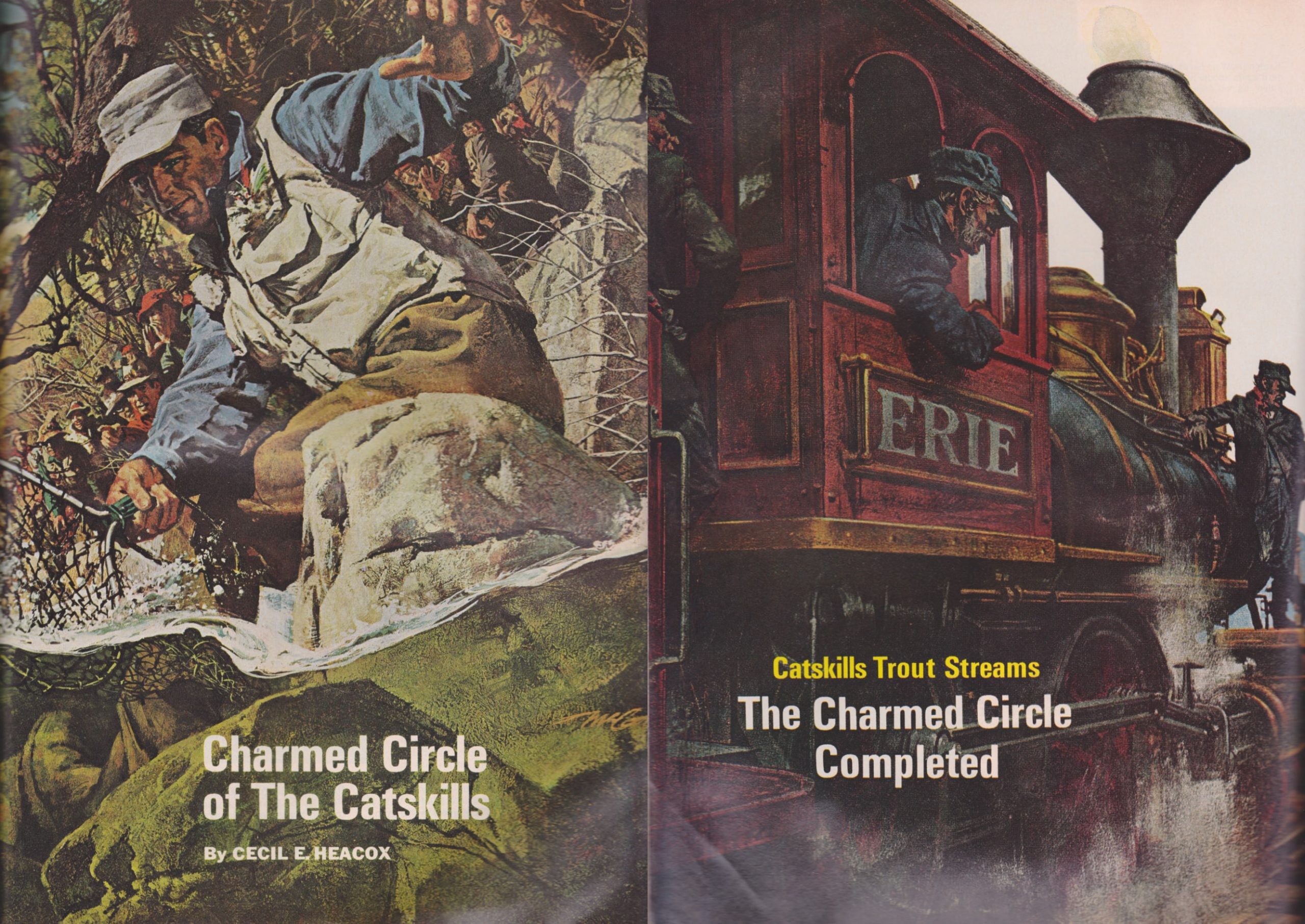
    In 1969, I read a two-part article written by Cecil E. Heacox that appeared in the March and April issues of Outdoor Life titled “Charmed Circle of The Catskills.” That poetic, yet simple, set of articles about the Catskills had a profound effect upon my life. Heacox wrote, “I call this region charmed because its fine fishing in wild, forested settings has survived even though it is within a day’s drive of one-sixth of the population of the United States and Canada.” He added, “The story of the Charmed Circle is touched with a mystical quality, trademark of the Catskills since the days of Rip Van Winkle.” In that two-part series, Heacox wrote about the many facets of trout fishing in the following Catskill streams: Rondout, Esopus, Schoharie, Beaverkill, Willowemoc, Neversink, and the Delaware. He skillfully took a neophyte like me on an enchanted piscatorial journey—one that I never forgot nor ventured too far from all these years later. Heacox pronounced the aforementioned rivers “topdrawer streams” because they were the “birthplace of dry-fly fishing in America, bailiwick of talented fly-tyers, and proving grounds for custom-rod makers” and “have lured fishermen from all corners of the world to the Charmed Circle for more than half a century.”

    Cecil Heacox was no ordinary flyfisher who just picked up a pen and began writing, mind you. No, he rose professionally through the ranks of the New York State Department of Environmental Conservation (DEC) from a junior aquatic biologist in the Catskills to regional fisheries manager to DEC’s deputy commissioner. Years after he retired, I had the very good fortune to meet him once—a true gentleman in every sense of the word.
    He autographed my copy of his 1974 book, The Compleat Brown Trout, and I thoroughly thanked him for his 1969 Outdoor Life articles. To this day I still have, and treasure, both copies of the original magazine articles.

    Wow! I’d seen these articles referenced before and the phrase “Charmed Circle” is now ubiquitous, but I hadn’t read them. I decided I needed to look them up and educate myself.

    Two hours of searching online later, I simply couldn’t find them, and I’m no slouch when it comes to tracking things down online. I looked everywhere I could think of: Library collections, Google Books, Outdoor Life’s website archives, the Internet Archive, etc. I found the scanned Outdoor Life 1898-1961 collection, but sadly that stopped eight years too soon. I’m pretty sure these articles weren’t available online. Dozens of references, but no original text.

    I was in the Charmed Circle that weekend, so I drove over to the Jerry Bartlett collection at the Phoenicia Library, figuring they’d have a copy. No dice. Lots of great works and I left with a long to-read list, but not the Cecil Heacox articles.

    I tried fruitlessly a few more times over the next couple days. Finally, I struck gold. Someone was selling all twelve 1969 issues of Outdoor Life magazine in an eBay auction. I snapped them up.

    Long story short, I scanned both articles and put them up on the Internet Archive so you can read these classics, too.

    Here they are:

    Enjoy!


    Update, 2026-04-17: The original copies I scanned now live at the Jerry Bartlett Angling Collection at the Phoenicia Library for others to enjoy. Thanks to Ed for facilitating that donation!

    I noticed that the Outdoor Life Magazine website republished Cecil Heacox’s March 1969 article today. I’m glad to see that! I’d like to think my tracking it down and sharing it in the fly fishing community prompted them to republish it online themselves. I may never know.

  • Big Apple Brook Trout

    Trout Unlimited is doing a citizen science project in our area: Environmental DNA sampling to locate hidden brook trout populations in the NYC suburbs: Fairfield, Westchester, Putnam, and Long Island.

    Their plan is to cover 400 miles of streams, starting with locations where there was historic Brook Trout presence, but no recent state sampling. Then expand to include other streams to find previously unknown populations. This will help guide TU in restoring and protecting the habitat for these native salmonids.

    Gerald Berrafati of the Mianus chapter is leading the effort. I met him out fishing the Amawalk last spring, so I decided to go out to his presentation at the Mianus chapter’s meeting to learn more. (I’m a part of the Croton chapter next door.)

    Big Apple Brook Trout — Mianus Chapter of Trout Unlimited
    www.mianustu.org

    They’ve already taken 130 samples and confirmed brook trout populations in 21 streams, with early signs that number could be as high as 40, including an unknown salter spawning population on Long Island. That is incredible in such a densely developed region.

    The way eDNA testing works:

    • Collect a water sample
    • Filter it to capture organic material
    • Extract and amplify DNA via PCR
    • Match against reference databases to identify species
    • Tag the results with GPS coordinates and add to a database

    You can learn more about it here:

    eDNA Primer – An introductory knowledge base on environmental DNA
    edna.dnabarcoding101.org

    The testing is so sensitive that it can detect fish a mile or two upstream of the sampling location. That is pretty wild. It only can tell you absence/presence though, nothing about the size of the actual population. It needs to be followed up with stream assessments, electro-fishing, and spawning surveys.

    Another citizen science tool TU has is the RIVERS app, where folks can submit on-the-ground information about a stream while they are out fishing. A geotagged photo of a brook trout is a great way to confirm presence. You can also tag old dams, erosion sites, etc. I downloaded it and will use it this season.

    I signed up to help in Westchester and Putnam. I’ve asked other fly fishers where they’ve caught brook trout in the area and have some ideas of places to check out. Charlie and I will go out on some hikes to take water samples in the spring once things thaw out. I need to get him some waders!

    TU gets their eDNA testing kits from Jonah Ventures. I’m going to buy one separately to sample Dickey Brook in Blue Mountain Reservation near our house. It primarily runs through protected land, has decent flows year-round, and has some macroinvertebrate life. I want to know what else is in there!

    Aquatic eDNA kit (fish + phytoplankton) – Jonah Ventures
    Using the JonahWater aquatic environmental DNA kit, you can reconstruct aquatic assemblages in your local water body! By filtering water and then sequencing the DNA on the filters, we can tell you the species of fish and algae that live in your neighborhood. Simply collect water in the syringe, push it through the filt
    store.jonahventures.com
  • Winter gift for the birds

    For the past three years, we’ve started the new year by going for a walk in the woods to collect pinecones and make a little treat for the birds. We roll them in peanut butter and birdseed, then go back out the next day and leave them on logs, tree stumps, and branches for the birds.

    It has become an accidental tradition and a fun way to start out the year by being out in nature, doing something together as a family, and being kind to the wild birds we enjoy watching in the woods.

    Collecting:

    Making:

    Distributing:

    While both collecting and distributing, we were fortunate to see the resident pileated woodpeckers hard at work hunting for bugs. The seed mix we used included sunflower seeds and peanuts, and we stuck a few pinecones in their trademark oval holes, so we hope they found them and had a snack.

  • Fallfish on the fly

    I went blue lining today in search of brook trout in NY near the CT border. I didn’t find any brookies, but I did catch 14 fallfish.

    Fallfish are a large native minnow species. All of the ones I caught were 6-10in long, but there were dozens of fingerling size in the stream, too.

    Even though I wasn’t targeting them, fallfish are fun to catch. They take flies, even dry flies, and they fight hard like trout. They are a lot of fun on a tenkara rod.

    See the little white bumps on the head of those one?

    I looked it up when I got home, and that means it is a spawning male. The bumps are called nuptial tubercles. That makes sense, because a little while later I saw two fallfish redds (nests) downstream of this. Both were large mounds of pebbles, 1.5-2ft in diameter, with lots of small fish around them.

    Fallfish males build the nest mounds out of pebbles, one stone at a time. Spawning is communal, although usually initiated by the nest builder, with a number of females and surrounding males using a single nest.

    I did release everything I caught today, and I didn’t disturb the redds. Once I noticed them, I moved to a different pool.

    Check out the video, it will be very clear where the redd is.

    A few other neat things I noticed around the stream today:

    Red Trillium:

    Blue heron tracks:

    Another set of tracks that I think are muskrat. Note the five toes, and short prints (front feet) aside long prints (hind feet).

    All in all, a great day on the stream. I’m going to keep this stream in mind in a couple years when Charlie is ready to learn how to cast a fly rod. The fallfish are fun to catch and there is plenty of casting room here. One section had some good pools without trees nearby. Also a good place to practice reading the water and detecting strikes.

  • Trout Releases & Macroinvertebrate Sampling

    Last Thursday and today I volunteered with the Croton Watershed chapter of Trout Unlimited to assist with a trout release and macroinvertebrate sampling at Cross River as part of the Trout in the Classroom program.

    In the fall, the New York State Department of Conservation sends trout eggs to schools. The students watch them hatch, learn about them, and care for them until spring, when they take a field trip to release the fingerlings into the wild.

    Last Thursday they released brown trout. Today (and the photo above) they released brook trout.

    During the field trip, the students also learn about the local watershed, test the water quality, and do some macroinvertebrate (bugs!) identification.

    That is where our TU chapter comes in. Before the students arrive, we put on our waders and go out into the river with a kick net and collect samples of bugs in the stream, and set up identification stations for the students to check out. Then we give a short introduction and float from group to group to answer questions and help them identify the bugs.

    It was a lot of fun. Cross River is an incredible stream, running through a protected area (Ward Pound Ridge Reservation), and the water quality is excellent. It only took us 10 minutes each day to collect more than the amount of macroinvertebrates we needed for the stations.

    We found:

    • Stoneflies
    • Rock caddis
    • Stick caddis
    • Free living caddis (green)
    • Net spinning caddis
    • Scuds
    • Cranefly larvae
    • Crayfish (lots!)
    • Mayflies (multiple species)
    • Hellgrammites (Dobsonfly larvae)
    • Water Pennies
    • Nematodes

    We even had an adult early stonefly land on the table so we could point out an adult stage of one of the nymphs.

    A mixed sample container
    Upper left: Stick cased caddis. Two mayflies, a stonefly, and a hellgrammite.
    Nematode, Crane fly larvae, hellgrammite, rock cased caddis, and lots of tiny mayflies
    Stonefly, Mayfly, nemotode, rock cased caddis, and net spinning caddis.
    Crane fly larvae
    Water Penny

    Some different kinds of caddisflies:

    Net spinning caddis
    Rock cased caddis
    Stick cased caddis and a rock cased caddis together
    Cased caddis outside of its case
    Crawfish and some mayflies

    I liked the charts we used for identification, so I found the PDFs online when I got home. I printed and laminated copies for myself to keep in my fishing bag!

    I was taken aback at how big the stoneflies were. At least size 8 hooks. The hellgrammites and craneflies were huge, too. I need to tie some bigger flies.

    I’ll no longer give the side eye to folks who tie mop flies, because I’ll be damned if they don’t look just like the crane fly larvae. The killer bugs look just like them, too.

    Afterward everything goes right back to the river.

    Of course, after the students leave we have a bit of free time to head upstream and fish for a bit! Last week I caught an early black stonefly hatch on the stream. All around great day!

  • Two wildflowers from a walk: Mullein and Ghost Pipe

    Two wildflowers from a walk: Mullein and Ghost Pipe

    I never remember the name of Mullein, Latin name Verbascum thapsus (left/first photo), so I thought I’d blog it in an attempt to remember.

    Fun facts about the Mullein: It does not flower until the second year, and an individual flower is only open for a single day.

    The second I saw for the first time and had to look it up when I got home: Ghost Pipe or Monotropa unifloraArchived Link. They are completely white, pop up from under the leaves in small bunches, and get their nutrients from tree roots via fungi. While they look like fungi themselves, they are regular flowering plants that are non-photosynthetic.

  • Calm morning on the Hudson

    Calm morning on the Hudson

  • Finding Wilderness Within Civilization

    I read this article from The Guardian about an ophthalmologist who is spending his retirement living out of a backpack and hiking all around the US. Most of it is only mildly interesting, but I loved this part:

    The next night, we slept in a copse of gnarled oaks beside a graveyard, a shady grove carpeted with slender, rippling leaves. It was strangely lovely. Eberhart found them everywhere, these forgotten little shards of wilderness. The problem, he said, was that hikers tended to divide their lives into compartments: wilderness over here, civilization over there. “The walls that exist between each of these compartments are not there naturally,” he said. “We create them. The guy that has to stand there and look at Mount Olympus to find peace and quiet and solitude and meaning – life has escaped him totally!”’

    I’ve found that it is very important for my well-being to seek out and spend time in this urban wilderness. I live in Yonkers, which isn’t nearly as dense as most parts of NYC, but life here is still dominated by apartments and concrete. For someone who grew up where houses, yards, and trees are the norm, finding these little places are necessary.  

    I’ve found three great refuges within walking distance of my apartment. I’m writing this post on my iPad from one of them right now. I like to go for a walk at least once a day and 4/5 days per week (weather permitting) I work outside from one of these spots. Working these places into my daily life greatly improves my well-being.

    While I’m not physically more than 50-100 yards from the street, the feel is completely different. Green replaces grey, the smell of grass and trees replace the smell of trash and exhaust fumes, and the sound of birds chirping replaces the sound of car engines.

    For times when you need to get away from the city completely, there are tons of great hiking spots within an hour’s drive of NYC: The Palisades, Bear Mountain, Doodletown, Breakneck Ridge, Anthony’s Nose, and Ramapo Lake to name a few. You can even reach a section of the Appalachian Trail by Metro North.

  • A Year Ago… Longs Peak

    A year ago today I summited Longs Peak in Estes Park, CO with a wonderful group of people from the RMNP ForumsArchived Link. We took the Keyhole Route. At 14,259 ft, Longs Peak was the first “fourteener” I’ve ever climbed. Here are a few photos by John Swadley. Click to enlarge. I will post some of my photos from the hike this coming week.

    Lora, Allen, Ed, and me (I am at the bottom of the photos) making our way across the Narrows.

    The group at the Boulderfield around 7 a.m. (after 3.5 hours of hiking already)

    Me on the Ledges

    At the summit!

    More photos to come soon! Stay tuned!

  • RMNP 3 of 5: Mount Ida

    On August 24, I posted this on my blog about August 23:

    “Today I got up before sunrise, breathed in the scent of pines as I traversed the mountainside, walked through clouds above the tree line, ate lunch next to a marmot on a mountain summit, gazed upon secluded mountain lakes, and was reminded how volatile Colorado weather is as I got caught in a hail storm at 12,880 ft. Today I remembered how beautiful and complex Earth is.”

    On the 23rd the Staffords and I woke up at 4:45 a.m., left the cabin at 6, and began hiking at 7 a.m. We started from Poudre Lake at Milner Pass. Our destination was the top of Mount Ida. We quickly made our way up the mountainside and emerged out of the pines and above the tree line. This was my first experience hiking in the alpine tundra. The air was a cool 40 degrees and the wind whipped by at 35 mph. The sky looked ominous and threatened rain. I knew the weather changes quickly above the tree line, so I was not terribly worried. As we hiked along the Continental Divide trail, clouds rolled in all around us. Click on the photo to see it larger. You can see Ben and Mrs. Stafford in the cloud:

    Gradually the clouds and light rain drifted off. For a while it seemed like it was clearing out just ahead of us. Then the sun broke through the ominous clouds and lit up the hillside:

    Visibility improved significantly once the sun broke through. We could the snowfields, Lake Granby of in the distance to the south, the Never Summer mountains to the west, and small lakes in the gorge to the east. Looking back on ground we already covered, I could see small unimproved trails winding across the hillside:

    The weather as we approached the summer was wonderful. The wind died down, blue skies raised our spirits, and marmots came out of their rocky dens. Here you can see the tundra in the foreground, the Never Summer mountains to the left, and the North Ridge to the right:

    We kept good pace and ascended the rocky incline to the summit in the sun with the occasional rolling cloud. We ate lunch on the summit–for me, peanut butter on flatbread, a dried fruit bar, a clif bar, and water. A marmot came out of his summit den and ate lunch near us––a nearby tuft of grass for him. Mr. Stafford took a photo of me on the summit just before lunch:

    From the summit we could see Inkwell, Azure, Highest, and Arrowhead lakes. This was a special experience for me because I realized these were the lakes I saw in 2007 with my parents from Trail Ridge Road. I told myself I would one day hike to them. I realized that I was just above them!

    As we sat peacefully eating our lunch and gazing upon Forest Canyon and the aforementioned lakes, Mrs. Stafford turned around to look off to the south and saw a huge storm where there was previously blue skies. It was heading our way. Not wanting to get caught in it, we scrambled to pack up our stuff. Then a problem arose. Mrs. Stafford could not find her camera. We search around for a few minutes, then I got my flashlight out and spotted it between some rocks. As I laid down and reached for it, the camera slid further down. Not wanting to waste time trying to fish it out, Ben, Mr. Stafford, and I worked together to move a few big rocks so that Mrs. Stafford could grab the camera.

    By this time the wind was whipping again and it started hailing on us for a few minutes. The weather is quite unpredictable at 12,880 ft. I quickly did my 10 summit pushups as per Dr. Steele’s request, then we quickly scrambled down from the summit and began the 5 mile treck back to the trailhead in the rain. I am very thankful that I brought my rain jacket. I was freezing in the fierce wind!

    After about 45minutes, the sun came back out. I shed my rain jacked and warmed up in the sun. The Staffords went on ahead while I took my time coming down to marvel at the beautiful scenery and take photos. There were still ominous clouds in the sky, but the weather stayed clear for the rest of the hike. Here is a shot looking at the North Ridge and the Continental Divide Trail:

    After a while I feared I was lagging too far behind, so I jogged for about 20 minutes to catch up with the Staffords. I caught up to Mr. and Mrs. Stafford, but Benjamin was nowhere to be found. He is a pretty fast hiker and was far ahead of everyone. I snapped a photo as I caught up with them:

    As we came back down into the tree line, we caught a glimpse of a bull elk with six points per antler. What a majestic creature!

    This was great hike. We experienced a 40 degree range of temperatures, multiple elements, and a few different terrains. The views were amazing. Besides for Longs Peak a few days later, this was my favorite hike of the trip.

  • RMNP 2 of 5: Blue Lake

    On day two the Staffords and I did an approximately 11 mile hike from the Glacier Gorge Trailhead to Blue Lake and back.

    Note: Click each photo to view it at a larger size.

    The Glacier Gorge region, shot from Blue Lake shelf on the upper east wall of Glacier Gorge:

    Ben and I took the regular trail to see Alberta Falls while Mr. and Mrs. Stafford took the shorter, less known fire trail and we met just before Mills Lake. (Mills is the large lake farther away in the photo above.) Ben and I weren’t very inspired by the falls and quickly hiked past it, making up time in order to meet his parents. We all stopped for a short rest and snack break around 2.5 miles in at Mills Lake.
    Across Mills Lake you can see the north west side of Longs Peak illuminated in the morning sun.

    I zoomed in with my telephoto lens and could see people at the top of Longs…that was us just a few days later!

    We continued along and hit Jewel Lake about 3.1 miles in. (Jewel is the closer, smaller lake in the Glacier Gorge photo above.) Across the lake on the south west side of Jewel Lake we saw a few elk soaking up the sun:

    We kept pushing along in order to reach Black Lake by lunch. Most of this time I had my camera in my pack (a nice Kelty Tornado which I found for $10 at a rummage sale the week before…a total steal!) I brought my camera back out around 4.7 miles in at Ribbon Falls. Here is a shot of the beautiful scenery we saw as we hiked up the rocks by a cascade from Black Lake:

    We ate our lunch at Black Lake. Above to the left is McHenry’s Peak and to the right is Arrowhead:

    We had approximately another mile of hiking and about 1000 feet in elevation gain to go in order to reach Blue Lake. The problem was that there is no path to it. It is not even on most maps. Most of the lakes above Black Lake require you to hike in their general direction and find them. This was definitely the case with Blue Lake. We followed a creek above Black Lake and then cut sharply left and in order to find Blue.

    Halfway up the creek I turned around and snapped a few photos of Black Lake, Arrowhead, and McHenry’s again:

    The beautiful area above Black Lake (Longs Peak is the flat one in the center):

    The Staffords, taken while we were trying to figure out where Blue Lake was:

    After much bushwhacking through krummholz and climbing up steep rocks, we finally made it to Blue Lake. The view from up there was worth the 5.5 mile, 2000 feet elevation gain one-way hike. The lake was beautiful and we could see almost the entire Glacier Gorge area (photo at the top).

    Ben scouts ahead and finds a good route to get down to the lake:

    Blue Lake!

    The south west edge of Blue Lake with the Spearhead in the distance:

    Here is a photo I forgot to post last time. After the Odessa Loop hike we went over to Sheep Lakes and got to see some Bighorn ewes come down the mountain to get some of the minerals in the lakes:

  • RMNP 1 of 5: Odessa Loop

    This is the first in a series of five posts about my trip to Rocky Mountain National Park back in August. I anticipated writing detailed posts, but I left my hiking journal at Hillsdale. I will try to recall my hikes from memory, but I will have to rely mostly on photos. I don’t remember the exact milages for each hike, but I do remember the approximate route. I will do my best. If you want a reference to the places I am referring to, consult this map (PDF).

    Click on the photos to view them at a larger size.

    The Staffords (Ben, Mrs. Stafford, and Mr. Stafford) near Lake Helene:

    The Stafford family was very gracious in inviting me to join them for a week-long hiking trip in Rocky Mountain National Park. We all stayed in a cabin just outside of Estes Park proper and drove in to the park early each morning.

    The first day we started at the Bear Lake trailhead around 7:30 a.m. We caught the Fern Lake Trail off of the Bear Lake Trail just north of Bear Lake and made our way west and north towards Odessa Lake.

    I paused shortly after Bear Lake as the trail climbed quickly upward to snap a photo of the morning light illuminating some leaves (click the photo for a larger view):

    We climbed up a little ways to Lake Helene. Here is the edge of Helene with Notchtop Mountain in the distance:

    Continuing on past Helene, we went through a pass on the north side of Joe Mills Mountain. This was our highest altitude of that day, at around 10,500 ft. Once while looking down over the valley I saw a massive bull elk making his way through the pines! Thankfully I did not experience any altitude sickness of any kind. I had plenty of water and I kept well hydrated.

    Here are the Staffords looking down on Odessa Lake from the trail on the north side of Joe Mills Mountain:

    Looking back at Notchtop from the same place:

    Once we got down to Odessa Lake we ate lunch. It was a little chilly, but the sun felt wonderful. I hiked in an athletic polo and hiking shorts most of the day.

    Odessa Lake:

    After lunch, we continued down to Fern Lake and rested there for a little while. We didn’t want to push ourselves too hard on the first day. I kicked back and watched some trout swim around in the cold mountain lake water.

    A glacial deposit just above Fern Lake:

    Afterwards we went on to Marguerite Falls, Fern Falls, and The Pool. Throughout the day we saw ptarmigan, marmot, pika, and elk! It was a great hike. I think it was approximately 7±1 miles, but I am not 100% sure. (I have it written down in my hiking journal up in Hillsdale.)

    Next: Glacier Gorge area

  • Hiking

    About Monday, August 23:

    Today I got up before sunrise, breathed in the scent of pines as I traversed the mountainside, walked through clouds above the tree line, ate lunch next to a marmot on a mountain summit, gazed upon secluded mountain lakes, and was reminded how volatile Colorado weather is as I got caught in a hail storm at 12,880 ft. Today I remembered how beautiful and complex Earth is.

    [Photos coming in a week when I get more reliable internet access.]

  • Great Day For a Hike

    I am in Estes Park, Colorado this week for the Foundation for Economic Education‘s Freedom Academy for high school students. (I know that I haven’t posted on my blog much this summer. I’ve been quite busy. I have a wonderful internship with the Foundation for Economic Education. I am working out of Atlanta with trips to Colorado and New York. More on that in a later post!) The seminar staff all flew in on Friday night, then we did as much prep work as we could in order to take some time to ourselves today before the students show up on Monday morning. Since we are right next to Rocky Mountain National Park, we decided to do a short 3.6 mile (roundtrip) hike in the late morning/early afternoon.

    Below are some of my photos from the hike. The Rockies are gorgeous! They are teeming with life and beauty. The hike was excellent- beautiful weather up until the last leg of the hike, cool temperatures, sun, and in one instance in the higher elevation, snow on the ground. I even saw wild cutthroat trout in a few of the mountain streams and lakes! I am coming back here in a month for a hiking trip with a friend of mine and his family. I can’t wait!

    Click on the photos to view them at a larger size. Enjoy!

    Bear Lake:

    Looking down on Bear Lake:

    Hallett Peak over Dream Lake:

    Water Lily on Bear Lake:

    Hallet Peak:

    Reflections on Bear Lake:

    Mountain Stream:

    Storms rolling in over Flattop Mountain and Emerald Lake:

    Here are a few shots of me taking two of the above photos. The shots of me were taken by Jason Hughey.