
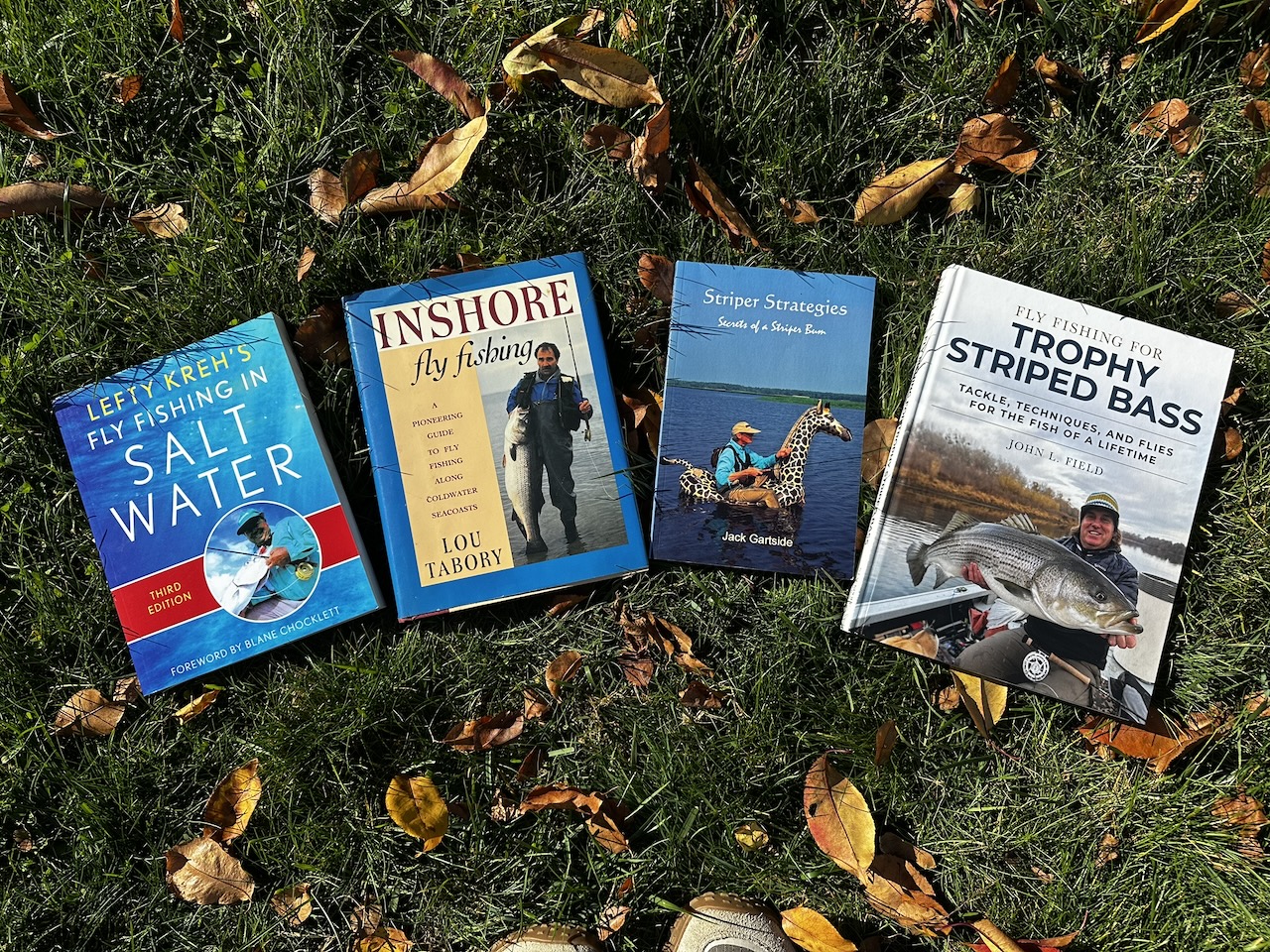
When I want to learn about a topic, my go-to approach is to buy three books on the subject and read them.
Here’s what I read to get started on fly fishing for striped bass.

Fly Fishing for Trophy Striped Bass by John L. Field.
I read this one first. This has a lot of great info about the major migrations, modern fly patterns, and interviews with guides from most of the common fisheries.

Striper Strategies: Secrets of a Striper Bum by Jack Gartside
If you already know where to go fish for striped bass and want to learn how to fish for them, this is the one book you should pick up. I read it at home, then revisited sections of it most evenings on Cape Cod before going out fishing again in the morning. Out of print, but there are both new and used copies available.

Inshore Fly Fishing by Lou Tabory
Though this isn’t only about striped bass, they are a big part of this book. I got this one used to learn the basics of coastal fly fishing: Reading rips, bars, beaches, flats, jetties, reefs, tidal estuaries, etc. For a stream fisherman, the ocean coast is a completely different challenge.
Bonus:

Fly Fishing in Salt Water by Lefty Kreh
Bonus! I hadn’t fly fished in salt water before, and I wanted to see if the great Lefty Kreh had anything different to say than Lou Tabory. He does, and this book is a good general intro book for salt water fly fishing, of which striped bass is just a small part. In fact, I’d say Tabory is better for cold salt water and Kreh is better for warm salt water.
I got into these too late to put them to use on the Hudson’s spring striper run, but I did get to try out my newly acquired knowledge on Cape Cod in August.
I eagerly tied a bunch of patterns on big salt water hooks before our family trip: Deceivers, shrimp, crabs, Gartside gurglers, sand eels, and Clouser minnows.


While out on the beach, Charlie found an actual sand eel, and it looked pretty close to what I tied! My eyes need to be smaller next time, though.


I fished the heck out of a tidal creek and a couple jetties within walking distance from where we were staying. I didn’t want to take up too much family time with fishing, so I got up before dawn most days to fish for a couple hours and be back at the house by breakfast.
I saw some beautiful sunrises, shore birds, and even a starfish. One morning a seal swam nearby, keeping up with me as I walked down the shore.


Unfortunately, I didn’t land a striper. I did get one fantastic surface take, which I lost. Later that evening, I re-read Gartside, who mentions the importance of using a strip set, not a trout set. Of course, I had trout set, pulling the gurgler out of its mouth. Damn.
I only saw a couple striped bass while out fishing, and none of the other folks fishing nearby seemed to have much luck, either. Perhaps this striper head I saw on the beach foreshadowed my fishing fate:

I did, however, hook something completely unexpected: A longfin squid! I had multiple encounters with them over a couple days. First I hooked one on a crab pattern, then the next day a bunch of them kept coming up to the surface to grab my gurgler. Their tentacles would come out of the water like a tiny horror, then my fly would be pulled under. They even left small beak marks on the gurgler’s foam.

I understand that hooking a squid on a single hook barbless fly was a fluke. Most squid lures have a lot of tiny hooks and look wicked.
A few learnings I jotted in my notebook for next time:
- All weighted flies need to be on jig hooks. Too many hangups on the bottom, especially the shrimp on the mussel beds.
- Use green crabs in the marsh and by rocks, calico and sand crabs in open water.
- Eyes should be fully covered in either epoxy or UV. They come off too easily.
- I need thicker foam and wider lips on my gurglers.
- Sand eels need much smaller eyes.
- Baitfish swim slowly upcurrent, retrieve more slowly.
I look forward to trying on the Hudson next spring. I have different patterns to tie, as the baitfish are completely different than on Cape Cod.

Leave a Reply